- +1-315-215-1633
- sales@thebrainyinsights.com

The global space defence systems market was valued at USD 37.56 Billion in 2024 and grew at a CAGR of 9.6% from 2025 to 2034. The market is expected to reach USD 93.94 Billion by 2034. The Global Space Defence Systems Market has become a crucial part of the larger defence and aerospace sector, fuelled by geopolitical tensions, advancements in satellite technologies, rising cyber-physical threats, and expanding investments in strategic space capabilities. This market encompasses a broad range of technologies and infrastructure elements, including space situational awareness (SSA), satellite communication (SATCOM), missile detection and early warning systems, anti-satellite (ASAT) weaponry, navigation and positioning technologies, surveillance and reconnaissance systems, and other enablers for space-based defence.
Space Defence Systems are comprehensive collections of technologies, infrastructures, platforms, and strategic doctrines designed to protect a nation's or coalition's space assets and capabilities from various threats. Their primary goal is to ensure the secure and ongoing use of space for strategic, military, and national security goals. These systems encompass a wide range of defence-related functions that operate in outer space or originate from there, with an emphasis on safeguarding infrastructure against hostile actions while maintaining situational awareness in space. They also facilitate both offensive and defensive operations within this domain. Unlike conventional ground-based defence mechanisms, these systems uniquely function within near-Earth space, requiring specialised technology adapted for the vacuum environment, which addresses challenges such as extreme distances, high velocities, and the complexities inherent in orbital mechanics.
Get an overview of this study by requesting a free sample
Expanding Military Reliance on Space for Operational Superiority – Modern warfare increasingly depends on space-based capabilities to achieve information dominance, coordinate commands, and ensure precision in engagements. Military operations across air, land, sea, cyber, and electronic domains are closely integrated with satellite platforms that provide real-time intelligence, surveillance and reconnaissance (ISR), secure communications, global navigation satellite systems (GNSS), weather forecasting, and targeting support. The seamless operation of these systems is crucial for theatre operations, as well as for strategic deterrence and tactical success. Disrupting even a small network of satellites can disrupt logistics efforts while degrading battlefield awareness by blinding ISR capacities altogether—this operational reliance drives nations toward developing more resilient solutions, such as fortified satellites incorporating AI-enhanced C4ISR networks alongside jam-resistant communication links, all of which contribute significantly to the exponential growth of the market. This factor contributes to the growth and development of the global space defence systems market.
High Capital and Budgetary Constraints – A major limitation in the global space defence systems market is the extremely high capital investment needed to develop, deploy, and maintain space-based defence infrastructure. Unlike terrestrial military assets, which can often be upgraded or repurposed, space defence platforms require multi-billion-dollar investments for each system. These ventures allow little margin for error and minimal post-deployment modification options. The costs associated with launching satellites, constructing them with encryption capabilities, radiation shielding, thermal regulation features, and ground station support significantly increase financial demands. Additionally, maintaining operational readiness over extended periods requires continuous funding for monitoring system operations, refuelling, repositioning, and technological updates. Emerging economies, including fiscally cautious developed nations, see this hefty initial cost as a formidable obstacle to entry scalability. This factor is hampering the market growth and development.
Emergence of Counterspace Capabilities as Strategic Tools – A key factor increasingly influencing the market is the development and implementation of counterspace technologies by both rival and allied nations. These technologies include kinetic ASAT weapons, co-orbital systems capable of intercepting satellites, electronic warfare platforms for jamming or spoofing communications, cyber tools targeting satellite ground stations, and laser systems designed to blind or degrade satellite sensors. The heightened awareness of such capabilities through military exercises, strategic demonstrations, and published doctrines emphasises the necessity for space defence systems capable of deterring, defending against, or neutralising these threats. This competitive escalation in offensive and defensive counterspace technology creates a cycle where advancements by one nation prompt reactive investments from others, thereby driving further market growth. This factor is anticipated to provide lucrative growth opportunities in the upcoming years.
The regions analyzed for the market include North America, Europe, South America, Asia Pacific, the Middle East, and Africa. North America emerged as the most significant global space defence systems market, with a 38% market revenue share in 2024.
This dominance is supported by the region's early embrace of space-based military technologies, substantial defence spending, and ongoing leadership in innovation. The formation of specialized military space agencies, such as the United States Space Force (USSF) and the Missile Defence Agency (MDA), as well as operational units within U.S. Space Command (USSPACECOM), underscores the strategic emphasis on achieving superiority in space. These organizations are responsible for coordinating efforts to develop and deploy advanced systems for missile warning, satellite communications, Earth observation, electronic warfare, and counter-space activities.
The U.S. maintains a well-organized space policy framework, influenced by the National Defence Strategy, Space Policy Directive-4, and various strategic initiatives that recognize space as a domain for warfare. The National Space Council collaborates with agencies such as NASA, the Department of Defence (DoD), and intelligence organizations to provide comprehensive situational awareness in space and coordinate national defence efforts. Meanwhile, Canada plays a supportive role through its participation in NORAD (North American Aerospace Defence Command) and increasing investments in areas such as space surveillance, satellite data management techniques, and Arctic domain monitoring initiatives.
North America Region Space Defence Systems Market Share in 2024 - 38%
www.thebrainyinsights.com
Check the geographical analysis of this market by requesting a free sample
The system segment is divided into Space-Based Missile Interceptors, Space Tracking and Surveillance System (STSS), Space-Based Infra-Red (SBIR), and Anti-Satellite (ASAT) Weapons. The Space Tracking and Surveillance System (STSS) segment dominated the market, with a market share of around 34% in 2024. The Space Tracking and Surveillance System (STSS) platforms comprise satellite constellations that utilize optical and radar technologies to monitor objects in orbit. They provide integrated data crucial for missile defence systems, especially those involving ground- or sea-based interceptors. The STSS segment is growing due to collaborations with commercial satellite tracking companies that offer cost-efficient data-as-a-service solutions accessible to military users within larger space command frameworks. The merging of military and commercial surveillance capabilities is broadening the vendor landscape, reducing threat detection latency, and facilitating proactive defence strategies. The increasing frequency of anti-satellite tests, errant satellite activities, and militarised operations in space has rendered real-time tracking capabilities essential for national security. As a result, the demand for STSS-type platforms is rising significantly, not only from the U.S. but also from Europe and countries in the Asia Pacific region.
The orbit segment is divided into Medium Earth Orbit (MEO), Low Earth Orbit (LEO), and Geostationary Orbit (GEO). The Low Earth Orbit (LEO) segment dominated the market, with a market share of around 44% in 2024. LEO satellites require considerably less launch energy than MEO and GEO satellites, enabling defence agencies and their partners to deploy and replenish satellite constellations more quickly and affordably. This aspect also makes them easier to replace, aligning with the demands of rapidly changing mission requirements where redundancy and flexibility are prioritised over longevity. The development of responsive launch platforms—especially from private defence firms and aerospace companies—has improved the practicality of sustaining continuous LEO coverage in challenging environments. Furthermore, advancements in miniaturisation have driven a surge in small-satellite constellations for missions such as space-based missile warning, synthetic aperture radar imaging, and real-time operations—all of which are generally launched into LEO.
| Attribute | Description |
|---|---|
| Market Size | Revenue (USD Billion) |
| Market size value in 2024 | USD 37.56 Billion |
| Market size value in 2034 | USD 93.94 Billion |
| CAGR (2025 to 2034) | 9.6% |
| Historical data | 2021-2023 |
| Base Year | 2024 |
| Forecast | 2025-2034 |
| Region | The regions analyzed for the market are Asia Pacific, Europe, South America, North America, and Middle East and Africa. Furthermore, the regions are further analyzed at the country level. |
| Segments | System and Orbit |
As per The Brainy Insights, the size of the global space defence systems market was valued at USD 37.56 billion in 2024 to USD 93.94 billion by 2034.
Global space defence systems market is growing at a CAGR of 9.6% during the forecast period 2025-2034.
The market's growth will be influenced by rising geopolitical tensions between the countries.
High expenditure costs could hamper the market growth.
This study forecasts revenue at global, regional, and country levels from 2021 to 2034. The Brainy Insights has segmented the global Space Defense Systems market based on below mentioned segments:
Global Space Defense Systems Market by System:
Global Space Defense Systems Market by Orbit:
Global Space Defense Systems Market by Region:
Research has its special purpose to undertake marketing efficiently. In this competitive scenario, businesses need information across all industry verticals; the information about customer wants, market demand, competition, industry trends, distribution channels etc. This information needs to be updated regularly because businesses operate in a dynamic environment. Our organization, The Brainy Insights incorporates scientific and systematic research procedures in order to get proper market insights and industry analysis for overall business success. The analysis consists of studying the market from a miniscule level wherein we implement statistical tools which helps us in examining the data with accuracy and precision.
Our research reports feature both; quantitative and qualitative aspects for any market. Qualitative information for any market research process are fundamental because they reveal the customer needs and wants, usage and consumption for any product/service related to a specific industry. This in turn aids the marketers/investors in knowing certain perceptions of the customers. Qualitative research can enlighten about the different product concepts and designs along with unique service offering that in turn, helps define marketing problems and generate opportunities. On the other hand, quantitative research engages with the data collection process through interviews, e-mail interactions, surveys and pilot studies. Quantitative aspects for the market research are useful to validate the hypotheses generated during qualitative research method, explore empirical patterns in the data with the help of statistical tools, and finally make the market estimations.
The Brainy Insights offers comprehensive research and analysis, based on a wide assortment of factual insights gained through interviews with CXOs and global experts and secondary data from reliable sources. Our analysts and industry specialist assume vital roles in building up statistical tools and analysis models, which are used to analyse the data and arrive at accurate insights with exceedingly informative research discoveries. The data provided by our organization have proven precious to a diverse range of companies, facilitating them to address issues such as determining which products/services are the most appealing, whether or not customers use the product in the manner anticipated, the purchasing intentions of the market and many others.
Our research methodology encompasses an idyllic combination of primary and secondary initiatives. Key phases involved in this process are listed below:
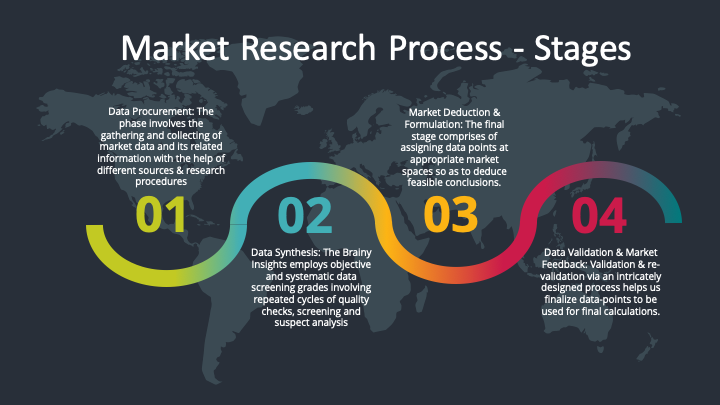
The phase involves the gathering and collecting of market data and its related information with the help of different sources & research procedures.
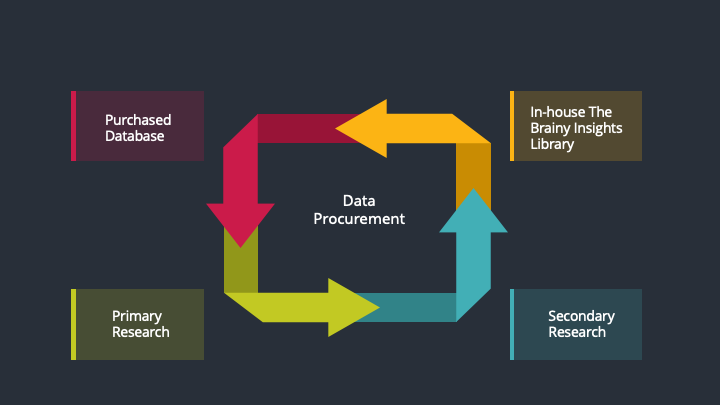
The data procurement stage involves in data gathering and collecting through various data sources.
This stage involves in extensive research. These data sources includes:
Purchased Database: Purchased databases play a crucial role in estimating the market sizes irrespective of the domain. Our purchased database includes:
Primary Research: The Brainy Insights interacts with leading companies and experts of the concerned domain to develop the analyst team’s market understanding and expertise. It improves and substantiates every single data presented in the market reports. Primary research mainly involves in telephonic interviews, E-mail interactions and face-to-face interviews with the raw material providers, manufacturers/producers, distributors, & independent consultants. The interviews that we conduct provides valuable data on market size and industry growth trends prevailing in the market. Our organization also conducts surveys with the various industry experts in order to gain overall insights of the industry/market. For instance, in healthcare industry we conduct surveys with the pharmacists, doctors, surgeons and nurses in order to gain insights and key information of a medical product/device/equipment which the customers are going to usage. Surveys are conducted in the form of questionnaire designed by our own analyst team. Surveys plays an important role in primary research because surveys helps us to identify the key target audiences of the market. Additionally, surveys helps to identify the key target audience engaged with the market. Our survey team conducts the survey by targeting the key audience, thus gaining insights from them. Based on the perspectives of the customers, this information is utilized to formulate market strategies. Moreover, market surveys helps us to understand the current competitive situation of the industry. To be precise, our survey process typically involve with the 360 analysis of the market. This analytical process begins by identifying the prospective customers for a product or service related to the market/industry to obtain data on how a product/service could fit into customers’ lives.
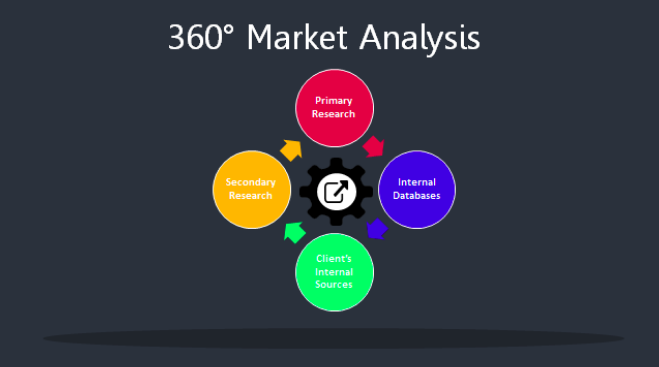
Secondary Research: The secondary data sources includes information published by the on-profit organizations such as World bank, WHO, company fillings, investor presentations, annual reports, national government documents, statistical databases, blogs, articles, white papers and others. From the annual report, we analyse a company’s revenue to understand the key segment and market share of that organization in a particular region. We analyse the company websites and adopt the product mapping technique which is important for deriving the segment revenue. In the product mapping method, we select and categorize the products offered by the companies catering to domain specific market, deduce the product revenue for each of the companies so as to get overall estimation of the market size. We also source data and analyses trends based on information received from supply side and demand side intermediaries in the value chain. The supply side denotes the data gathered from supplier, distributor, wholesaler and the demand side illustrates the data gathered from the end customers for respective market domain.
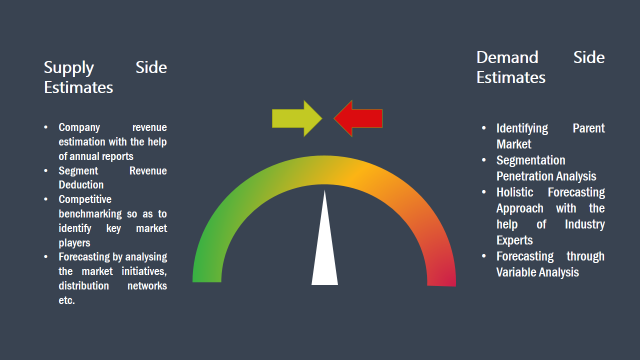
The supply side for a domain specific market is analysed by:
The demand side for the market is estimated through:
In-house Library: Apart from these third-party sources, we have our in-house library of qualitative and quantitative information. Our in-house database includes market data for various industry and domains. These data are updated on regular basis as per the changing market scenario. Our library includes, historic databases, internal audit reports and archives.
Sometimes there are instances where there is no metadata or raw data available for any domain specific market. For those cases, we use our expertise to forecast and estimate the market size in order to generate comprehensive data sets. Our analyst team adopt a robust research technique in order to produce the estimates:
Data Synthesis: This stage involves the analysis & mapping of all the information obtained from the previous step. It also involves in scrutinizing the data for any discrepancy observed while data gathering related to the market. The data is collected with consideration to the heterogeneity of sources. Robust scientific techniques are in place for synthesizing disparate data sets and provide the essential contextual information that can orient market strategies. The Brainy Insights has extensive experience in data synthesis where the data passes through various stages:
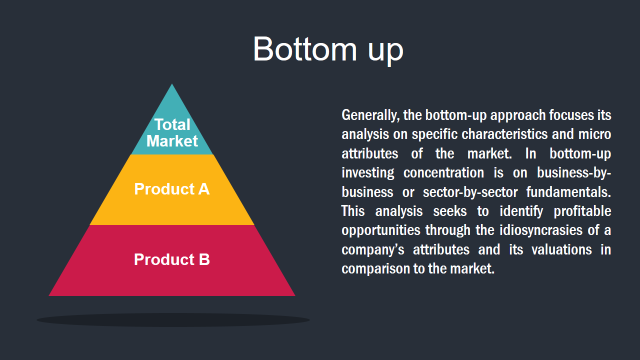
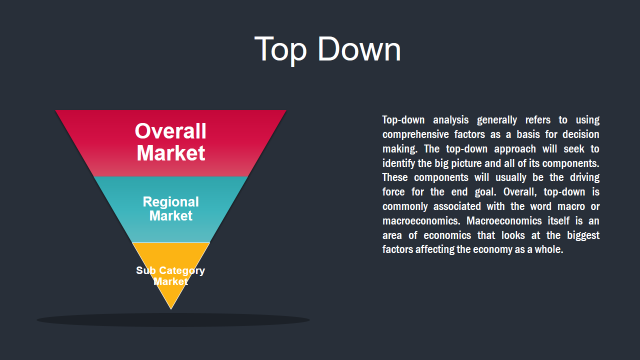
Market Deduction & Formulation: The final stage comprises of assigning data points at appropriate market spaces so as to deduce feasible conclusions. Analyst perspective & subject matter expert based holistic form of market sizing coupled with industry analysis also plays a crucial role in this stage.
This stage involves in finalization of the market size and numbers that we have collected from data integration step. With data interpolation, it is made sure that there is no gap in the market data. Successful trend analysis is done by our analysts using extrapolation techniques, which provide the best possible forecasts for the market.
Data Validation & Market Feedback: Validation is the most important step in the process. Validation & re-validation via an intricately designed process helps us finalize data-points to be used for final calculations.
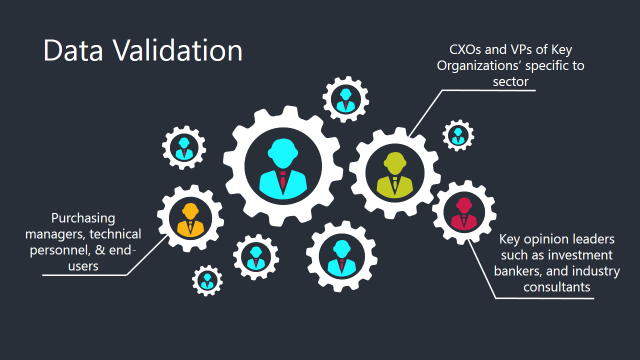
The Brainy Insights interacts with leading companies and experts of the concerned domain to develop the analyst team’s market understanding and expertise. It improves and substantiates every single data presented in the market reports. The data validation interview and discussion panels are typically composed of the most experienced industry members. The participants include, however, are not limited to:
Moreover, we always validate our data and findings through primary respondents from all the major regions we are working on.



















































Free Customization
Fortune 500 Clients
Free Yearly Update On Purchase Of Multi/Corporate License
Companies Served Till Date