- +1-315-215-1633
- sales@thebrainyinsights.com

The global space-based solar power market was valued at USD 2.87 billion in 2024 and grew at a CAGR of 8% from 2025 to 2034. The market is expected to reach USD 6.19 billion by 2034. The increasing energy demands will drive the growth of the global space-based solar power market.
Space-based solar power (SBSP) is the idea of gathering solar energy in space with the orbiting satellites and sending it back terrestrially as a wireless transmission. This concept is based on the fact that in space the radiation by the sun is much more compared to the surface of the earth where the radiation is scattered and intermittently blocked by clouds, atmosphere, and darkness. Its main working is involving installing big solar panel arrays on geostationary satellites as a means of transforming sunlight into electric power. This energy is then turned into microwaves or laser beams and sent to the ground based receiving stations (rectennas) where it is turned back to workable electricity. The ultimate way that SBSP is better is that it can produce continuous and uninterrupted energy where ground-based solar panels are restricted by the time of day and weather conditions. Satellites in geostationary orbit are able to receive sunlight almost 24 hours a day, which is why SBSP has the potential of transforming renewable energy provision and grid stability. It also has a strategic advantage of energy self-sufficiency and may be applied in powering remote or disaster-hit areas without necessarily having to establish ground-based complex facilities. Nonetheless, although SBSP can be a promising technology, it is under heightened prospects of technical, economical, and environmental challenges. A major concern of constructing and installing large solar arrays in space is the prohibitive expense of launching and putting these arrays together. Wireless powering, more specifically through microwaves, has to be demonstrated to be effective and safe in larger scale, and lead to no hazard to aircraft, spacecraft, or the environment. Reliability of the structure, efficiency of energy conversion, and sustained orbital equipment of the long-term are also of great concern.
Get an overview of this study by requesting a free sample
Technological advancements – The capacity of SBSP to give continuous and non-interrupted energy provision is driving research and development in the industry. The market is also being driven by technological innovations in the use of wireless power transmission. Advances in microwave and laser energy beaming have also enhanced efficiency in power transmission using the space as intermediary between the transmitting and the receiving areas with a minimal loss in transmission. At the same time, ultra-light and compliant materials allowed massively scaled up solar arrays to be built that do not make a major impact in launch weight or cost, which is important in getting overall project cost-down. What is more, the increase in the efficiency of solar panels has been critical. Higher efficient photovoltaic helps to produce more electricity out of allotment of smaller surfaces maximizing the production of a small system. This is also facilitated by the robotic and autonomous technologies which allow cost-efficient assembly and repairs of the huge structures in space without human operators. All these factors lead to a decrease in operational costs, increase reliability of the systems along with showing technological preparedness of the SBSP systems, which plays a significant role in the increased popularity in the energy market across the world.
Cost, complexity and operational challenges – the prohibitive cost as well as complexity in the development and deployment of SBSP systems is probably one of the greatest obstacles. New technologies, that are not yet economical at scale, involved in designing, manufacturing, launching, and assembling massive solar arrays and wireless power transmission infrastructure in space, is among the most difficult tasks which at the moment is considered impossible in practice. The large volume and weight of these systems is even beyond the capabilities of current launch vehicles which may need to be launched several times, or assembled in-orbit using autonomous robotics, which further drives the costs and risk upwards. The other equal concern is energy transmission efficiency and safety. The technology of SBSP is based on transforming the solar energy to microwaves or lasers that it can beam it to the earth and although there has been significant test conducted, the transmission efficiency is quite low. Furthermore, orbital refuelling and repair is a major challenge and therefore the reliability and sustainability are at stake. Such technical obstacles along with the fact that no reliable, commercially implemented systems are in place leads to low investor confidence.
Increasing energy demands and favourable policies – the increasing demand of clean and renewable energy worldwide is one of the most powerful external stimuli. As countries undertake the commitment of low carbon emissions and the need to cut down fossil fuels, SBSP is an efficient long-term solution to sustainable energy generation with minimum effects on the environment. The potential to deliver high-capacity energy without interruption is what makes it particularly useful when considering the rise in the demand of electricity in the world and climate ambitions. Other important motivators are energy security and strategic autonomy. The goal of many nations is to create well balanced energy sources and decrease dependency on imported energy or infrastructural vulnerability on the ground. SBSP systems have potential to deliver decentralized, space-based power which is not sensitive to natural calamities, interstate politics, or ground-based assaults. This qualifies SBSP to be of special interest to defence, emergency-response, and powering-critical-infrastructure. In addition, another convincing factor is the need of dependable energy in the off-grid and remote areas, such as islands, military bases, and disaster-impacted localities. Such locations could be provided with clean electricity by SBSP without having to use massive ground infrastructure. Simultaneously, the growing number of investments in the space technology and the involvement of the private companies working in the sphere of aerospace suggest a tendency to lower the expenses and speed up the growth. The ecosystem is further boosted by government programs, global partnerships and government policy initiatives on space-based clean energy options.
The regions analyzed for the market include North America, Europe, South America, Asia Pacific, the Middle East, and Africa. Asia Pacific emerged as the most significant global space-based solar power market, with a 39% market revenue share in 2024.
Asia-Pacific would become the most dominating region in the global space-based solar power (SBSP) market mainly because of the proactive participation of the technologically advanced countries such as Japan and China. Such nations have shown serious intentions of attaining energy sustainability and strategic independence by use of space-based power generation. Japan as a country has been researching and developing SBSP systems since 1990s through its national space agency JAXA and has ambitious targets of rolling out functioning solar power satellites as early as the 2030s. The leadership is evident in the country considering its innovative works of wireless power transmission as well as its partnership with other private and academic entities. China has been also developing quickly in this direction, her government-sponsored space programme has scheduled to launch an orbit-based solar power station with 1-megawatt power capacity by 2030. In addition, the strength of Asia-Pacific is backed by policies, great energy requirements because of high levels of urbanization, and the need to lessen dependence on fossil fuels. Regional countries are looking at SBSP as a permanent solution to the issues of energy security and carbon neutrality targets.
Asia Pacific Region Space-Based Solar Power Market Share in 2024 - 39%
www.thebrainyinsights.com
Check the geographical analysis of this market by requesting a free sample
The type of energy transmission segment is divided into microwave transmission and laser transmission. The microwave transmission segment dominated the market, with a market share of around 67% in 2024. The space-based solar power (SBSP) market is dominated by microwave transmission as it is the most desirable technology of wirelessly broadcasting energy to the earth owing to its technological maturity, efficiency, and comparative safety. The microwaves (usually of the 2.45-5.8 GHz region) are well-known as they have been in use since decades primarily in satellite communication, radar, and wireless systems. This background of knowledge offers an excellent base to adapt the technology into energy transmission in the SBSP systems. Its capacity to propagate through the atmosphere of earth without major interference by clouds, rain and conditions in atmosphere is another major strength of the system of transmissions by microwave which makes them deliver more reliable energy supply as compared to laser-based systems that are more vulnerable to interference caused by weather conditions. It is also possible to have larger, more diffuse energy beams in the microwave systems which are safer in the terrestrial environments and manageable in terms of safety and regulation terms as well. This attribute is critical towards ensuring that the population trusts and averts concerns on environmental and health issues. Furthermore, Microwave transmission-based systems are already proven to good effect in small scale experiments, with organizations like JAXA and NASA experimentally confirming proof of concept with such systems. The safety-safety profile and adaptability of microwave systems provide the system systems the leading piece in the SBSP transmission technologies.
The satellite type segment is divided into geostationary earth orbit (GEO) satellites, medium earth orbit (MEO) satellites and low earth orbit (LEO) satellites. The geostationary earth orbit (GEO) satellites segment dominated the market, with a market share of around 46% in 2024. Geostationary Earth Orbit (GEO) provides a special monopoly in terms of space-based solar power (SBSP) market by virtue of its downlinking- and uplinking solar power collection together with transmission. The GEO satellites are positioned above the equator on Earth to enable them to orbit the earth at the same speed and hence appear to be in the same position as a point on the earth surface. They can experience continuous exposure to sunlight (approximately 99% of the year) without going through the day-night cycle and the atmospheric upheavals that concern terrestrial and lower-orbit systems. This uninterrupted availability of solar radiation guarantees optimal utilization of energy and hence the GEO satellites are most suitable to produce power 24 hours and to provide a stable energy to the fixed rectennas on the ground. It is also easier to align, design energy-beaming systems since their position is stationary thus makes it easier to target and track the receivers on the earth, much easier. Moreover, a wider field of view is available in GEO satellites, which makes them transmit power to a greater geographical range, a fact necessary to serve utility-scale locations and to distribute energy over cross-country distances.
The application segment is divided into utility-scale power generation, military & defence applications, remote and off-grid power supply and disaster relief and emergency power. The utility-scale power generation segment dominated the market, with a market share of around 36% in 2024. The largest area of application in space-based solar power (SBSP) market is utility-scale power project, and the application is based mainly on the fact that it serves the growing global need of clean energy tools that enable large-scale and continuous energy power. SBSP systems, and more specifically those in geostationary orbits, would be in a unique position to provide continuous solar energy even independent of the day night cycle of the earth and independent of the time of the year and weather conditions. This renders them extremely desirable to utility-scale uses, where a steady and high-power supply is needed by national grids. The nature of SBSP technology is that which can only be constructed on a massive scale and not on a small individual or commercial scale. Utility-scale SBSP is an opportunity that governments and energy agencies believe is a strategic response to achieving decarbonization objectives and the diversification and assurance of energy supply. Moreover, with the world going green rapidly, utility-scale SBSP may become the backbone of clean energy in countries where land supply is small or where the terrestrial ability to generate solar power is unreliable.
The end-user segment is divided into government & space agencies, commercial energy providers, defence organizations and research institutions. The government & space agencies segment dominated the market, with a share of around 48% in 2024. Space-based solar power (SBSP) market is dominated by government and space agencies considering the huge amount of capital required, technical difficulty, as well as long-term strategic prospects related to space-based solar power (SBSP) applications. SBSP engages with sophisticated aerospace technology, wireless power transmission and orbital facilities all of which require immense financing and co-ordination at scientific, military and regulatory levels which national governments are best placed to provide. Other agencies like NASA (U.S.), JAXA (Japan), ESA (Europe) and CNSA (China) are on the forefront in developing SBSP as they not only have an expertise in the technologies of using satellites but also have access to space infrastructure. These organizations have turned on feasibility studies, small scale tests and technology demonstrations that set the basis of future large scale SBSP systems. In addition, the governmental finance lowers the risk in new technologies thus the partnership in the private sector can expand over time. The orbital solar energy is also viewable as fitting into the larger policy objectives of the government such as climate change mitigation, energy independence.
| Attribute | Description |
|---|---|
| Market Size | Revenue (USD Billion) |
| Market size value in 2024 | USD 2.87 Billion |
| Market size value in 2034 | USD 6.19 Billion |
| CAGR (2025 to 2034) | 8% |
| Historical data | 2021-2023 |
| Base Year | 2024 |
| Forecast | 2025-2034 |
| Region | The regions analyzed for the market are Asia Pacific, Europe, South America, North America, and Middle East and Africa. Furthermore, the regions are further analyzed at the country level. |
| Segments | Type of Energy Transmission, Satellite Type, Application and End User |
As per The Brainy Insights, the size of the global space-based solar power market was valued at USD 2.37 billion in 2024 to USD 6.19 billion by 2034.
Global space-based solar power market is growing at a CAGR of 8% during the forecast period 2025-2034.
The market's growth will be influenced by technological advancements.
Cost, complexity and operational challenges could hamper the market growth.
This study forecasts revenue at global, regional, and country levels from 2021 to 2034. The Brainy Insights has segmented the global space-based solar power market based on below mentioned segments:
Global Space-Based Solar Power Market by Type of Energy Transmission:
Global Space-Based Solar Power Market by Satellite Type:
Global Space-Based Solar Power Market by Application:
Global Space-Based Solar Power Market by End-User:
Global Space-Based Solar Power Market by Region:
Research has its special purpose to undertake marketing efficiently. In this competitive scenario, businesses need information across all industry verticals; the information about customer wants, market demand, competition, industry trends, distribution channels etc. This information needs to be updated regularly because businesses operate in a dynamic environment. Our organization, The Brainy Insights incorporates scientific and systematic research procedures in order to get proper market insights and industry analysis for overall business success. The analysis consists of studying the market from a miniscule level wherein we implement statistical tools which helps us in examining the data with accuracy and precision.
Our research reports feature both; quantitative and qualitative aspects for any market. Qualitative information for any market research process are fundamental because they reveal the customer needs and wants, usage and consumption for any product/service related to a specific industry. This in turn aids the marketers/investors in knowing certain perceptions of the customers. Qualitative research can enlighten about the different product concepts and designs along with unique service offering that in turn, helps define marketing problems and generate opportunities. On the other hand, quantitative research engages with the data collection process through interviews, e-mail interactions, surveys and pilot studies. Quantitative aspects for the market research are useful to validate the hypotheses generated during qualitative research method, explore empirical patterns in the data with the help of statistical tools, and finally make the market estimations.
The Brainy Insights offers comprehensive research and analysis, based on a wide assortment of factual insights gained through interviews with CXOs and global experts and secondary data from reliable sources. Our analysts and industry specialist assume vital roles in building up statistical tools and analysis models, which are used to analyse the data and arrive at accurate insights with exceedingly informative research discoveries. The data provided by our organization have proven precious to a diverse range of companies, facilitating them to address issues such as determining which products/services are the most appealing, whether or not customers use the product in the manner anticipated, the purchasing intentions of the market and many others.
Our research methodology encompasses an idyllic combination of primary and secondary initiatives. Key phases involved in this process are listed below:
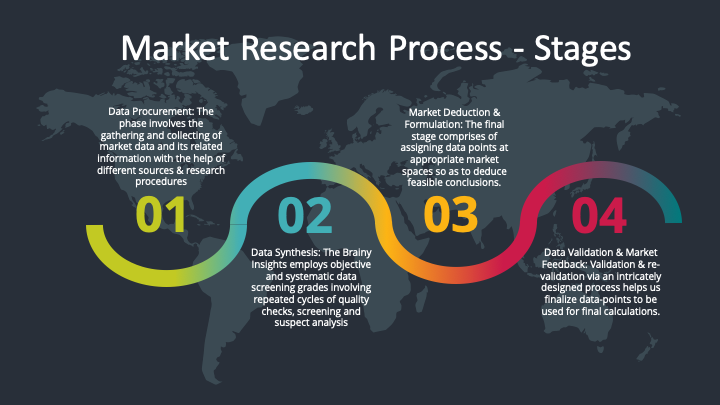
The phase involves the gathering and collecting of market data and its related information with the help of different sources & research procedures.
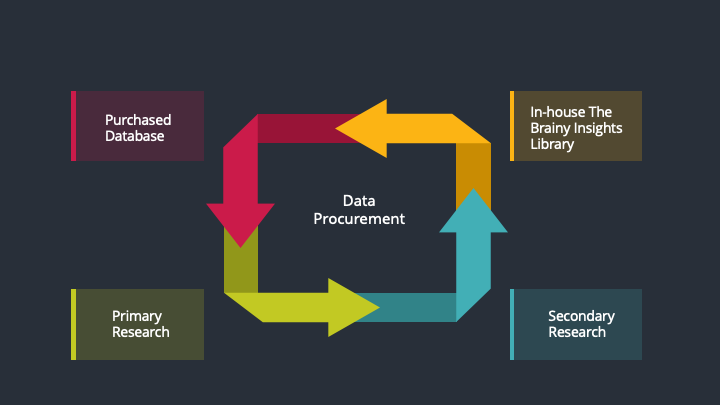
The data procurement stage involves in data gathering and collecting through various data sources.
This stage involves in extensive research. These data sources includes:
Purchased Database: Purchased databases play a crucial role in estimating the market sizes irrespective of the domain. Our purchased database includes:
Primary Research: The Brainy Insights interacts with leading companies and experts of the concerned domain to develop the analyst team’s market understanding and expertise. It improves and substantiates every single data presented in the market reports. Primary research mainly involves in telephonic interviews, E-mail interactions and face-to-face interviews with the raw material providers, manufacturers/producers, distributors, & independent consultants. The interviews that we conduct provides valuable data on market size and industry growth trends prevailing in the market. Our organization also conducts surveys with the various industry experts in order to gain overall insights of the industry/market. For instance, in healthcare industry we conduct surveys with the pharmacists, doctors, surgeons and nurses in order to gain insights and key information of a medical product/device/equipment which the customers are going to usage. Surveys are conducted in the form of questionnaire designed by our own analyst team. Surveys plays an important role in primary research because surveys helps us to identify the key target audiences of the market. Additionally, surveys helps to identify the key target audience engaged with the market. Our survey team conducts the survey by targeting the key audience, thus gaining insights from them. Based on the perspectives of the customers, this information is utilized to formulate market strategies. Moreover, market surveys helps us to understand the current competitive situation of the industry. To be precise, our survey process typically involve with the 360 analysis of the market. This analytical process begins by identifying the prospective customers for a product or service related to the market/industry to obtain data on how a product/service could fit into customers’ lives.
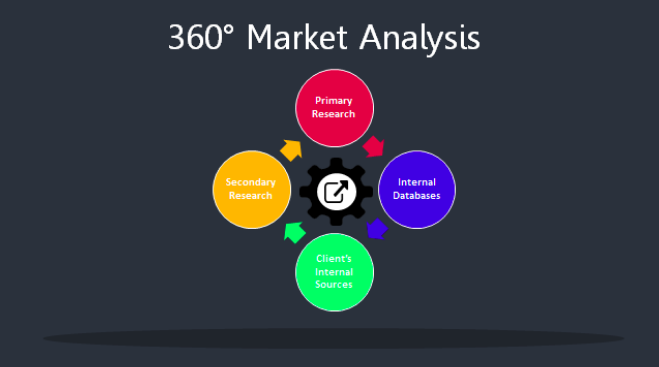
Secondary Research: The secondary data sources includes information published by the on-profit organizations such as World bank, WHO, company fillings, investor presentations, annual reports, national government documents, statistical databases, blogs, articles, white papers and others. From the annual report, we analyse a company’s revenue to understand the key segment and market share of that organization in a particular region. We analyse the company websites and adopt the product mapping technique which is important for deriving the segment revenue. In the product mapping method, we select and categorize the products offered by the companies catering to domain specific market, deduce the product revenue for each of the companies so as to get overall estimation of the market size. We also source data and analyses trends based on information received from supply side and demand side intermediaries in the value chain. The supply side denotes the data gathered from supplier, distributor, wholesaler and the demand side illustrates the data gathered from the end customers for respective market domain.
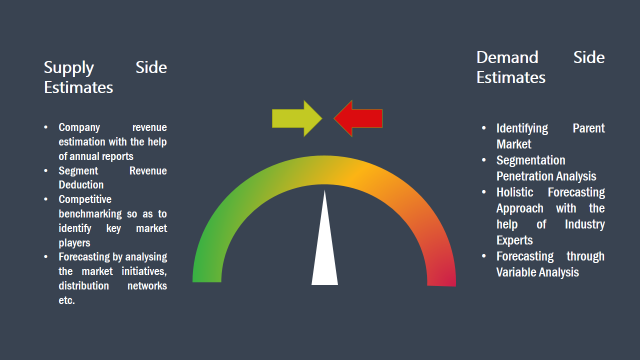
The supply side for a domain specific market is analysed by:
The demand side for the market is estimated through:
In-house Library: Apart from these third-party sources, we have our in-house library of qualitative and quantitative information. Our in-house database includes market data for various industry and domains. These data are updated on regular basis as per the changing market scenario. Our library includes, historic databases, internal audit reports and archives.
Sometimes there are instances where there is no metadata or raw data available for any domain specific market. For those cases, we use our expertise to forecast and estimate the market size in order to generate comprehensive data sets. Our analyst team adopt a robust research technique in order to produce the estimates:
Data Synthesis: This stage involves the analysis & mapping of all the information obtained from the previous step. It also involves in scrutinizing the data for any discrepancy observed while data gathering related to the market. The data is collected with consideration to the heterogeneity of sources. Robust scientific techniques are in place for synthesizing disparate data sets and provide the essential contextual information that can orient market strategies. The Brainy Insights has extensive experience in data synthesis where the data passes through various stages:
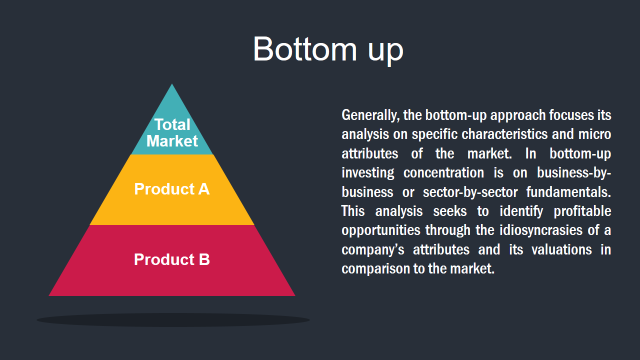
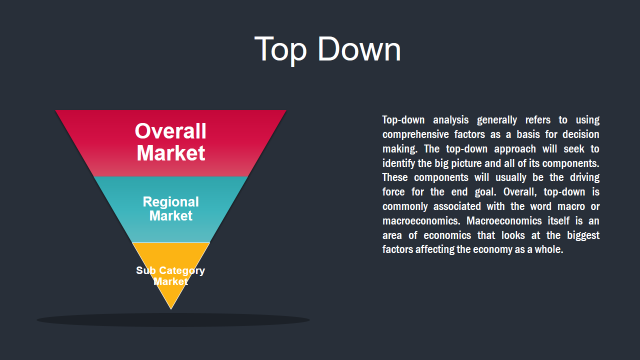
Market Deduction & Formulation: The final stage comprises of assigning data points at appropriate market spaces so as to deduce feasible conclusions. Analyst perspective & subject matter expert based holistic form of market sizing coupled with industry analysis also plays a crucial role in this stage.
This stage involves in finalization of the market size and numbers that we have collected from data integration step. With data interpolation, it is made sure that there is no gap in the market data. Successful trend analysis is done by our analysts using extrapolation techniques, which provide the best possible forecasts for the market.
Data Validation & Market Feedback: Validation is the most important step in the process. Validation & re-validation via an intricately designed process helps us finalize data-points to be used for final calculations.
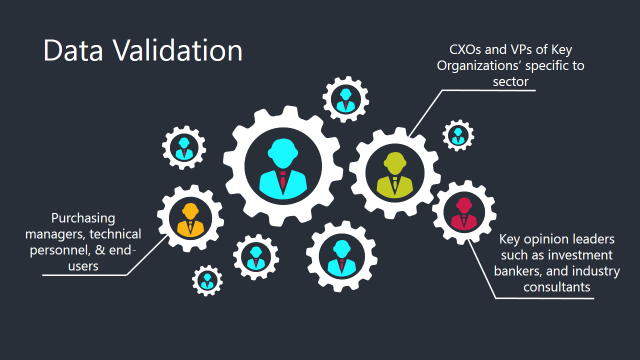
The Brainy Insights interacts with leading companies and experts of the concerned domain to develop the analyst team’s market understanding and expertise. It improves and substantiates every single data presented in the market reports. The data validation interview and discussion panels are typically composed of the most experienced industry members. The participants include, however, are not limited to:
Moreover, we always validate our data and findings through primary respondents from all the major regions we are working on.


















































Free Customization
Fortune 500 Clients
Free Yearly Update On Purchase Of Multi/Corporate License
Companies Served Till Date