- +1-315-215-1633
- sales@thebrainyinsights.com

The global satellite launch services market was valued at USD 19 billion in 2024 and grew at a CAGR of 14% from 2025 to 2034. The market is expected to reach USD 70.43 billion by 2034. The increasing investments will drive the growth of the global satellite launch services market.
Satellite launch services describe the entire procedures and infrastructure necessary to transport a satellite to its intended orbit around the earth. Such services are vital for the launching of satellites to aid telecommunications, Earth observation, navigation, weather forecasting, scientific research and military. The essence of the satellite launch services comprises planning of missions, integrating the launch vehicle, encapsulating payload, launching of the satellite and subsequent support. It starts with the choice of an appropriate launch vehicle depending on the mass of the satellite, the orbit in which the satellite might be required (low Earth orbit, geostationary orbit, or polar orbit) and the mission. Compared to the past where national space agencies such as NASA, Roscosmos, and ISRO had monopolized the market, in the recent years, private companies have changed the game in the industry by lowering the prices and frequency of launch, such as reusable rockets to SpaceX, Blue Origin, and Rocket Lab. Also, the launch services are a significant component of the space economy in general and are impacted by the propulsion technologies, developments in the international space collaboration, regulatory environments, and national policies.
Get an overview of this study by requesting a free sample
Technological advancements and innovations – among the most revolutionary trends is the satellite miniaturization allowing to develop small-sats and CubeSats. Weight and size of these nanosatellites make them considerably cheaper to fund and launch, resulting in the raising number and variety of missions, especially by academical guests, start-ups and companies. This pattern has also led to the development of specialize-small-satellite launching vehicles that are intended to be launched at low expense and in a short time. The increasing popularity of the satellite constellations as communications and navigation tools as well as observing tools is also an urgently pressing consideration. The constellations need several launches extended in the future, so there will be constant demand and need of launch services. The development and maturation of the reusable launch vehicles are equally an influential pattern involving the development and the use of the reusable launch vehicles through organizations such as SpaceX. The reusability significantly brings per-launch costs down and shortens the turnaround time between launches, which allows making launch services more affordable to a larger number of customers. Furthermore, better launch infrastructure such as more launch pads and time flexibility in launches has boosted the capacity and responsiveness of the entire industry. Competition and innovation have also grown due to the increased involvement of players of the private sector, which has resulted in expanded services, including ride-sharing services and services and launch integration services. When added together, such internal dynamics are transforming the satellite launch ecosystem into something more cost-effective, agile, and need-responsive than it has ever been.
Technological, operational and infrastructural challenges – the costs associated with satellite integration, manufacturing of vehicles, fuel, and launching activities are quite huge and hence incapacitating small firms and developing countries to penetrate the industry. Also, the space and riskiness of launching satellite can put off investment. Financial losses and loss of credibility among service providers occur because technical problems, failures during launch and delay of missions besides making a service provider lose money, also makes potential clients weary. The other constraint is that of compatibility problems of the payloads and the launch vehicles. In addition, the availability of launching windows of specific orbits (e.g. geostationary or sun-synchronous) is scarce and generates a competition that leads to bottlenecks in scheduling. This is also subject to infrastructure limitations: most areas do not have sophisticated launch sites, tracking networks, transport systems to make regular, dependable operations. Such concentration of power onto hands of a few major players constrains accessibility and capacity on the market. All these internal issues make satellite launches more expensive, more cumbersome, and with higher lead time, which may disincentivize new investment and restrict market growth.
Social and geopolitical political factors – the growing global need to connect everyone, especially in underdeveloped areas has resulted in high numbers of communication satellites being deployed, in particular low-Earth orbit constellations delivering high speed broadband services. On the same note, the incremental significance of the Earth observation in monitoring climate, agriculture, and disaster management as well as resources management necessitates governments and other private companies to invest in satellite-based solutions, thus necessitating numerous launches. Within the field of defence and national security, nations are increasing their access to satellite technologies to monitor, achieve secure communications and to track missiles, such that space comes to be a vital component of national strategic capability. The commercial space industry is boosted also by the beneficial government policies and funding programs. Various countries are forming space-friendly regulatory systems, smoothing the system of approving the license to launch into space, and providing benefits to enhance national satellite and launch sectors.
The regions analyzed for the market include North America, Europe, South America, Asia Pacific, the Middle East, and Africa. North America emerged as the most significant global satellite launch services market, with a 40% market revenue share in 2024.
The region is home to top market players such as SpaceX, United Launch Alliance (ULA), Blue Origin, and Northrop Grumman. It is only SpaceX whose reusable Falcon 9 and Falcon Heavy rockets have transformed the industry by undertaking high frequency and cost-efficient launches, with opportunities to serve both the government and the commercial customer across the globe. These businesses have largely expanded the launch rate, volume and volume share of the region in the international market. Governmental space agencies, such as NASA or the U.S. Department of Defence, remain key clients, which steadily boosts the demand due to the programs on Earth observation, exploration, and national security. Furthermore, considering the United States, the U.S. regulatory, as well as financial ecosystems have deeply contributed to the commercialization of space, as venture capital, together with public-private partnerships, has allowed the quick expansion of new entrants and startups. Satellite manufacturing and launch partnership is another source of power that Canada has to offer to the region. Furthermore, North America has some facilities in a state of art including Cape Canaveral Space Force Station, Vandenberg Space Force Base, and the Mojave Air and Space Port, which offer strategic flexibility regarding the different mission profiles.
North America Region Satellite Launch Services Market Share in 2024 - 40%
www.thebrainyinsights.com
Check the geographical analysis of this market by requesting a free sample
The payload type segment is divided into small satellites (≤500 kg), medium satellites (500–1,000 kg) and heavy satellites (>1,000 kg). The small satellites (≤500 kg) segment dominated the market, with a market share of around 56% in 2024. This is the category usually referred to as satellites with less than 500 kilograms which includes nanosatellite, microsatellite as well as the CubeSats which is gradually finding broad spectrum of commercial, scientific and defences applications. The favourable development of engineering, electronics, sensors, and materials has enormously cut down the costs of development and launch, making space accessible to startups and universities, as well as developing countries. This has led to an increased number of demands in the small satellite segment, which is driven by industries dealing with earth observation, remote sensing, asset tracking and broad band international internet, among others. One of the biggest contributors to this prominence is the emergence of artificial clusters (constellations) of small satellites, either hundreds or thousands of them. Moreover, small satellites also provide quicker lead time between idea and implementation compared to traditional satellites which fit into the dynamism of commercial space applications and flexible space projects.
The orbit type segment is divided into low earth orbit (LEO), medium earth orbit (MEO), geostationary orbit (GEO) and sun-synchronous orbit (SSO). The low earth orbit (LEO) segment dominated the market, with a market share of around 38% in 2024. Low Earth orbit (LEO) has taken a leading position in the satellite launch services market globally, mostly because of the footprint in high-frequency, low-latency communication, observation of the Earth, and technological experimentation. Orbits within the altitude of 160 km to 2,000 km determined by the sea level just above the surface of the earth are called LEO. It is close to Earth, and the satellites can save their power and transmit their data much faster, and this aspect makes it the best option when it comes to broadband internet, live imaging, and scientific work. In contrast to geostationary orbits that take longer to develop, cost more to launch into orbit, and are heavy and bulky, LEO enables deployment of small, less expensive, and nimble networks of satellites. Due to an unprecedented jump in demand of global connection, particularly in underserved and distant areas, LEO satellites with constellations are multiplying at high rates. SpaceX (Starlink), OneWeb, and Amazon (Project Kuiper) companies are launching thousands of small satellites into LEO with the intention of offering low-latency broadband, globally. Such mega-constellations demand constant, dependable launch services which help the rise and prevalence of LEO missions.
The launch platform segment is divided into land-based launches, air-based launches and sea-based launches. The land-based platforms segment dominated the market, with a market share of around 61% in 2024. The land-based launches prevail in the world market of satellite launch services given their established infrastructure, the predictable capability to face operations, and the ability to launch payloads of different categories and missions. Most large launch sites are on land, with the main ones being the Cape Canaveral in the United States, Baikonur Cosmodrome in Kazakhstan, Guiana Space Centre in French Guiana and the Satish Dhawan Space Centre in India. The logistical benefit of these spaceports is that they provide gifted infrastructure, such as control centres, testing facilities, integration bays, fuel storage, and recovery to comply with complex launch operations, as well as the mitigation of the risk of mission. Heavy-lift and reusable rockets, like SpaceX Falcon 9, ISRO PSLV and GSLV, and ULA Atlas V and Vulcan, also currently launch into space using land platforms. Also, the land bases can carry out both Equatorial and polar launches, depending on the geographic location unlike the sea or Air alternative. This superiority of land-based launch is also vested by the economies of scale and the track record that it already has which increases customer confidence and attracts both commercial and government clients.
The end user segment is divided into commercial sector, government & defence and academic & research institutions. The commercial sector segment dominated the market, with a share of around 55% in 2024. The commercial sector has ranked as the largest end user of global satellite launch services market through the fast advancement of technology, greater investment by the business community, as well as expansion of the services in a variety of sectors. In contrast to the previous decades when the main users of satellite launches were the government looking to achieve military or research goals, the contemporary market is becoming more dominated by the activities of the commercial enterprises who hope to take advantage of the commercial potentials of the space, including telecommunications, internet connectivity, remote sensing of the Earth, and data analysis. The increased consumer demand in high-speed global broadband, particularly in underserved and remote areas further necessitated the development of big satellite constellations by commercial providers such as SpaceX (Starlink), OneWeb, and Amazon (Project Kuiper) which all require high frequency and scalable launch services. Besides communications, commercial Earth observation businesses are also launching constellations in the agriculture, infrastructure observing, environmental evaluation, and disaster-response domains. Such services are data intensive and require high-resolution, high speed revisit capabilities, ideally available by use of small, multiple satellites in low earth orbits. The reduced barrier to entry has taken the form of the increased access to economical launching options such as ridesharing and dedicated small sat launches which has emboldened startups, research institutes and even non-traditional players to join the space missions. Moreover, the interest of the venture capital and healthy regulatory changes has led to the rapid rate of the involvement of the private sector.
| Attribute | Description |
|---|---|
| Market Size | Revenue (USD Billion) |
| Market size value in 2024 | USD 19 Billion |
| Market size value in 2034 | USD 70.43 Billion |
| CAGR (2025 to 2034) | 14% |
| Historical data | 2021-2023 |
| Base Year | 2024 |
| Forecast | 2025-2034 |
| Region | The regions analyzed for the market are Asia Pacific, Europe, South America, North America, and Middle East and Africa. Furthermore, the regions are further analyzed at the country level. |
| Segments | Payload Type, Orbit Type, Launch Platform and End User |
As per The Brainy Insights, the size of the global satellite launch services market was valued at USD 19 billion in 2024 to USD 70.43 billion by 2034.
Global satellite launch services market is growing at a CAGR of 14% during the forecast period 2025-2034.
The market's growth will be influenced by technological advancements and innovations.
Technological, operational and infrastructural challenges could hamper the market growth.
This study forecasts revenue at global, regional, and country levels from 2021 to 2034. The Brainy Insights has segmented the global Satellite Launch Services market based on below mentioned segments:
Global Satellite Launch Services Market by Payload Type:
Global Satellite Launch Services Market by Orbit Type:
Global Satellite Launch Services Market by Launch Platform:
Global Satellite Launch Services Market by End User:
Global Satellite Launch Services Market by Region:
Research has its special purpose to undertake marketing efficiently. In this competitive scenario, businesses need information across all industry verticals; the information about customer wants, market demand, competition, industry trends, distribution channels etc. This information needs to be updated regularly because businesses operate in a dynamic environment. Our organization, The Brainy Insights incorporates scientific and systematic research procedures in order to get proper market insights and industry analysis for overall business success. The analysis consists of studying the market from a miniscule level wherein we implement statistical tools which helps us in examining the data with accuracy and precision.
Our research reports feature both; quantitative and qualitative aspects for any market. Qualitative information for any market research process are fundamental because they reveal the customer needs and wants, usage and consumption for any product/service related to a specific industry. This in turn aids the marketers/investors in knowing certain perceptions of the customers. Qualitative research can enlighten about the different product concepts and designs along with unique service offering that in turn, helps define marketing problems and generate opportunities. On the other hand, quantitative research engages with the data collection process through interviews, e-mail interactions, surveys and pilot studies. Quantitative aspects for the market research are useful to validate the hypotheses generated during qualitative research method, explore empirical patterns in the data with the help of statistical tools, and finally make the market estimations.
The Brainy Insights offers comprehensive research and analysis, based on a wide assortment of factual insights gained through interviews with CXOs and global experts and secondary data from reliable sources. Our analysts and industry specialist assume vital roles in building up statistical tools and analysis models, which are used to analyse the data and arrive at accurate insights with exceedingly informative research discoveries. The data provided by our organization have proven precious to a diverse range of companies, facilitating them to address issues such as determining which products/services are the most appealing, whether or not customers use the product in the manner anticipated, the purchasing intentions of the market and many others.
Our research methodology encompasses an idyllic combination of primary and secondary initiatives. Key phases involved in this process are listed below:
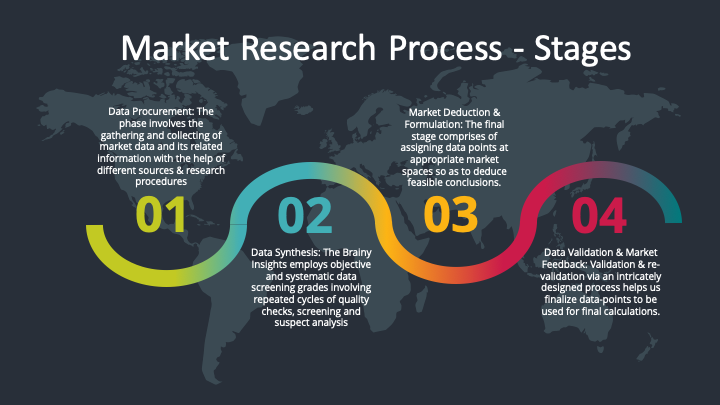
The phase involves the gathering and collecting of market data and its related information with the help of different sources & research procedures.
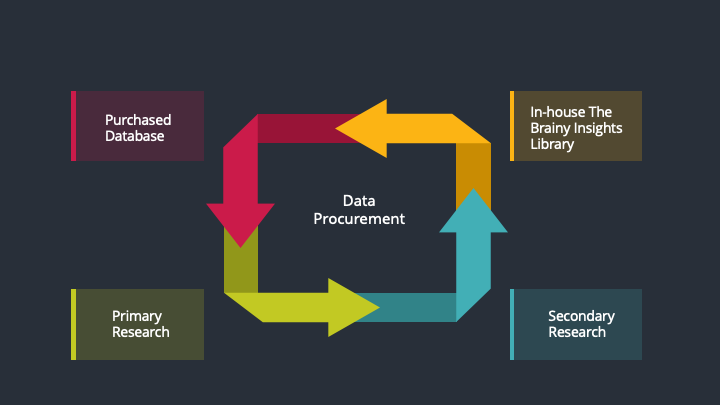
The data procurement stage involves in data gathering and collecting through various data sources.
This stage involves in extensive research. These data sources includes:
Purchased Database: Purchased databases play a crucial role in estimating the market sizes irrespective of the domain. Our purchased database includes:
Primary Research: The Brainy Insights interacts with leading companies and experts of the concerned domain to develop the analyst team’s market understanding and expertise. It improves and substantiates every single data presented in the market reports. Primary research mainly involves in telephonic interviews, E-mail interactions and face-to-face interviews with the raw material providers, manufacturers/producers, distributors, & independent consultants. The interviews that we conduct provides valuable data on market size and industry growth trends prevailing in the market. Our organization also conducts surveys with the various industry experts in order to gain overall insights of the industry/market. For instance, in healthcare industry we conduct surveys with the pharmacists, doctors, surgeons and nurses in order to gain insights and key information of a medical product/device/equipment which the customers are going to usage. Surveys are conducted in the form of questionnaire designed by our own analyst team. Surveys plays an important role in primary research because surveys helps us to identify the key target audiences of the market. Additionally, surveys helps to identify the key target audience engaged with the market. Our survey team conducts the survey by targeting the key audience, thus gaining insights from them. Based on the perspectives of the customers, this information is utilized to formulate market strategies. Moreover, market surveys helps us to understand the current competitive situation of the industry. To be precise, our survey process typically involve with the 360 analysis of the market. This analytical process begins by identifying the prospective customers for a product or service related to the market/industry to obtain data on how a product/service could fit into customers’ lives.
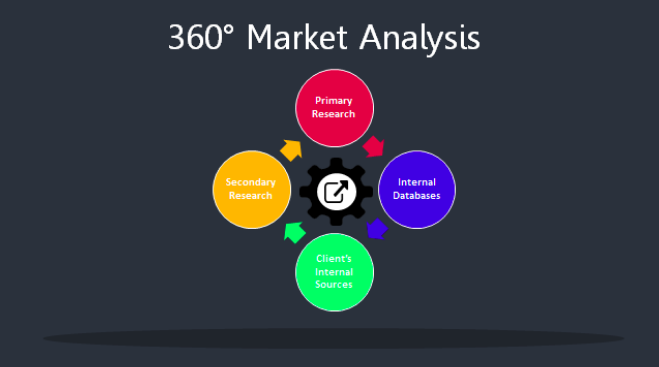
Secondary Research: The secondary data sources includes information published by the on-profit organizations such as World bank, WHO, company fillings, investor presentations, annual reports, national government documents, statistical databases, blogs, articles, white papers and others. From the annual report, we analyse a company’s revenue to understand the key segment and market share of that organization in a particular region. We analyse the company websites and adopt the product mapping technique which is important for deriving the segment revenue. In the product mapping method, we select and categorize the products offered by the companies catering to domain specific market, deduce the product revenue for each of the companies so as to get overall estimation of the market size. We also source data and analyses trends based on information received from supply side and demand side intermediaries in the value chain. The supply side denotes the data gathered from supplier, distributor, wholesaler and the demand side illustrates the data gathered from the end customers for respective market domain.
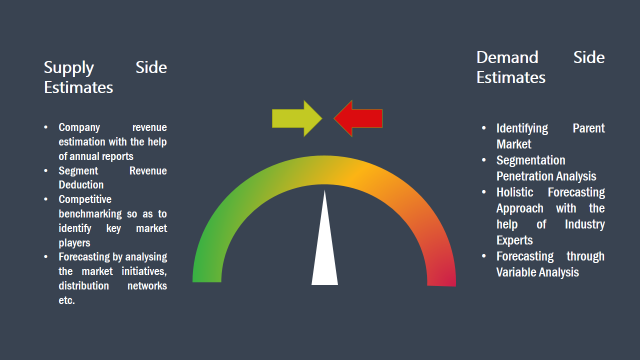
The supply side for a domain specific market is analysed by:
The demand side for the market is estimated through:
In-house Library: Apart from these third-party sources, we have our in-house library of qualitative and quantitative information. Our in-house database includes market data for various industry and domains. These data are updated on regular basis as per the changing market scenario. Our library includes, historic databases, internal audit reports and archives.
Sometimes there are instances where there is no metadata or raw data available for any domain specific market. For those cases, we use our expertise to forecast and estimate the market size in order to generate comprehensive data sets. Our analyst team adopt a robust research technique in order to produce the estimates:
Data Synthesis: This stage involves the analysis & mapping of all the information obtained from the previous step. It also involves in scrutinizing the data for any discrepancy observed while data gathering related to the market. The data is collected with consideration to the heterogeneity of sources. Robust scientific techniques are in place for synthesizing disparate data sets and provide the essential contextual information that can orient market strategies. The Brainy Insights has extensive experience in data synthesis where the data passes through various stages:
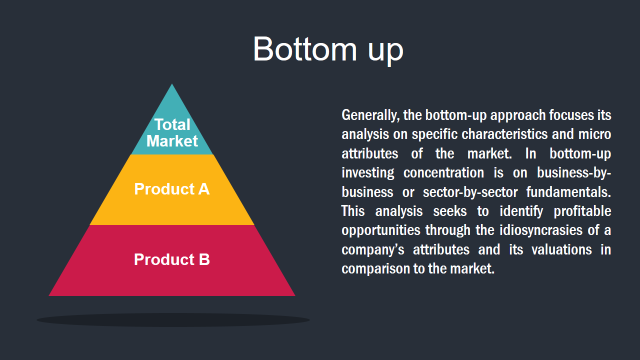
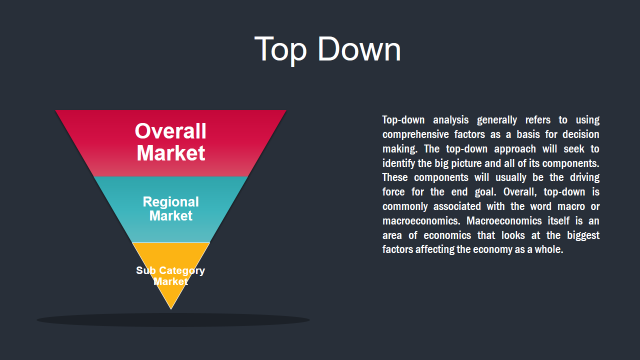
Market Deduction & Formulation: The final stage comprises of assigning data points at appropriate market spaces so as to deduce feasible conclusions. Analyst perspective & subject matter expert based holistic form of market sizing coupled with industry analysis also plays a crucial role in this stage.
This stage involves in finalization of the market size and numbers that we have collected from data integration step. With data interpolation, it is made sure that there is no gap in the market data. Successful trend analysis is done by our analysts using extrapolation techniques, which provide the best possible forecasts for the market.
Data Validation & Market Feedback: Validation is the most important step in the process. Validation & re-validation via an intricately designed process helps us finalize data-points to be used for final calculations.
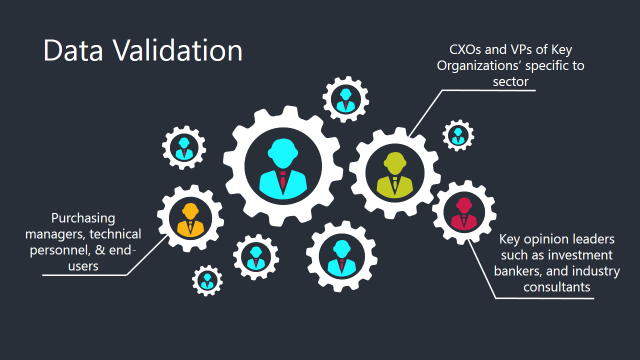
The Brainy Insights interacts with leading companies and experts of the concerned domain to develop the analyst team’s market understanding and expertise. It improves and substantiates every single data presented in the market reports. The data validation interview and discussion panels are typically composed of the most experienced industry members. The participants include, however, are not limited to:
Moreover, we always validate our data and findings through primary respondents from all the major regions we are working on.



















































Free Customization
Fortune 500 Clients
Free Yearly Update On Purchase Of Multi/Corporate License
Companies Served Till Date