- +1-315-215-1633
- sales@thebrainyinsights.com

The global mobile commerce market was valued at USD 1.60 Trillion in 2024 and growing at a CAGR of 6.80% from 2025 to 2034. The market is expected to reach USD 3.09 Trillion by 2034. Through mobile commerce (also known as m-commerce), a wide range of services and goods can be sold or purchased using wireless devices. Through this, goods and services can be booked remotely and accessed at any time. Mobile commerce is very popular in today's era, and the main reason for this is that the devices work at a fast speed and are more secure than before. These devices need to be secure because the buyer will need to complete this process by making a payment, which will be done online with the help of the internet. For this, the device must be secure. Through mobile commerce, sellers can target a large customer base, and with the help of mobile commerce analytics, they can create and mould their sales strategy by understanding customer behaviour. Apart from this, customers can also be attracted by giving discounts. Mobile commerce also provides customers with a variety of products and offers, enabling them to easily select the desired products from multiple sellers and complete the purchase within their budget. Apart from this, customers can also read and post reviews of products and services, making it easier for other customers to purchase the product or service.
Get an overview of this study by requesting a free sample
Rise in Adoption of Mobile Wallets and Contactless Payments - Mobile wallets and contactless payment technologies provide convenience to both buyers and sellers. Due to this facility, consumers also adopt it easily. Due to mobile wallets and contactless payment technologies, customers no longer have to re-enter their card details, which promotes instant buying. These new payment technologies are so secure that they can be easily trusted, which boosts user confidence, and as a result, both customer engagement and retention remain high. Features such as biometric authentication and multi-factor authentication are used to enhance the security of these technologies, making them more secure and safer than traditional payment methods. Due to these technologies, features such as buy now, pay later and subscription payments can also be introduced. Both customers and sellers benefit from these. Due to these features, the volume of transactions can increase, which is beneficial for mobile commerce.
Digital Divide and Low Smartphone Penetration - Even in this advanced and technology-driven era, many countries still use feature phones. Especially in low-income and rural areas, people cannot afford such phones. Additionally, many consumers lack sufficient education, which hinders their ability to operate smartphones effectively. Due to these restrictions, potential customers are not able to take advantage of mobile commerce. Apart from this, a lack of internet connectivity can also hinder the growth of this market, as mobile commerce is primarily conducted online. In such areas, people still rely on cash and have not adopted this technological advancement. Due to this, many mobile commerce companies do not invest in such areas because they are considered high-risk zones, as it is difficult to get returns from them.
AI-driven personalization in Mobile Commerce- With the help of AI-driven personalization, sellers can easily understand customer behaviour, and with its help, the seller can adjust the pricing of their products or services. Apart from this, with the help of artificial intelligence, the needs and buying behaviour of customers can be understood, and products and services can be provided accordingly. Apart from this, a separate strategy can be prepared for each customer, and products can be recommended to them based on their needs and preferences, thereby making them potential customers. Apart from this, artificial intelligence can also be used for security purposes, enabling the detection of unusual activities and the identification of fraudsters, thereby ensuring that user data remains secure and belongs to the customer.
Security & Privacy Risks - Mobile commerce is conducted over the internet. As a result, there is always a security risk and concern about the theft of private data on these apps and websites. Due to this, customers may be hesitant to adopt mobile commerce. As technology advances, people are taking advantage of it in the wrong way, which means the purpose of creating these technologies, originally intended to provide convenience to people, is not being fulfilled. To make these apps secure, companies will have to invest a lot financially, due to which small or new players will have more difficulty in entering the mobile commerce business, apart from this, the company will take the expense of building this secure app from the customer in the form of subscription cost, due to which the customer will not adopt mobile commerce.
The regions analyzed for the market include North America, Europe, South America, Asia Pacific, the Middle East, and Africa. North America emerged as the largest market for the global mobile commerce market, with a 40% share of the market revenue in 2024.
North America has a highly tech-savvy population, making the adoption of technology relatively easy. Due to this, the adoption of new technologies has always been easy in this region. Apart from this, it is a developed region which attracts many big players who develop such technologies to deliver their services and products to customers easily. For this, they invest a lot. These companies develop apps with features that enable the product to be easily displayed to customers on the app, along with detailed specifications, making it easier for customers to make a decision. Consumers in North America place a higher preference on convenience, which enables service-based industries to grow easily in the region. Apart from this, the disposable income in this region is also very high, enabling the population to afford such services easily. Apart from this, existing mobile commerce companies analyze consumer behaviour and suggest discounts and products according to their needs, which keeps customer engagement intact and encourages customers to visit the apps regularly.
North America Region Mobile Commerce Market Share in 2024 - 40%
www.thebrainyinsights.com
Check the geographical analysis of this market by requesting a free sample
The transaction type segment is divided into M retailing, M ticketing/booking, M billing and others. The M retailing segment dominated the market, with a market share of 45% in 2024. Most transactions are conducted through M-retailing. The primary reason for this is the growing adoption of smartphones. Apart from this, in today's fast-paced and technologically advanced era, everyone wants to save time, and for that, they are also willing to spend extra money. Due to this, people prefer mobile retailing more. Because after using it, people do not need to visit physical stores. M-retailing is directly connected to mobile wallets, which means that both the customer and the seller face no problems during shopping.
The payment modes segment is divided into near-field communication (NFC), premium SMS, wireless application protocol (WAP), direct carrier billing and others. The near-field communication segment dominated the market, with a market share of 36% in 2024. Near-field Communication (NFC) is the fastest and secure mode of payment. Its process is also very simple; transactions are completed through tap-end methods, which saves a significant amount of time, and the receiver also receives the money instantly. NFC utilizes biometric authentication and tokenization, which help protect the user's data and reduce the risk of fraud. The government of every country is also promoting the deployment of NFC and is trying to make as many cashless payments as possible.
The device type segment is divided into smart devices and feature phones. The smart devices segment dominated the market, with a market share of 65% in 2024. Smart devices possess numerous advanced capabilities, enabling a single device to perform the work of multiple devices. The interface of these devices is also extremely user-friendly, allowing users to use them easily. The price of these smart devices is also kept low, allowing all consumers to afford them. Many security features are launched in the market today, and regular updates are also provided to users so that their data can be protected from new threats. Due to this, they are used more in m-commerce.
| Attribute | Description |
|---|---|
| Market Size | Revenue (USD Trillion) |
| Market size value in 2024 | USD 1.60 Trillion |
| Market size value in 2034 | USD 3.09 Trillion |
| CAGR (2025 to 2034) | 6.80% |
| Historical data | 2021-2023 |
| Base Year | 2024 |
| Forecast | 2025-2034 |
| Region | The regions analyzed for the market are Asia Pacific, Europe, South America, North America, and Middle East & Africa. Furthermore, the regions are further analyzed at the country level. |
| Segments | Transaction Type, Payment Modes and Device Type |
As per The Brainy Insights, the size of the mobile commerce market was valued at USD 1.60 Trillion in 2024 to USD 3.09 Trillion by 2034.
The global mobile commerce market is growing at a CAGR of 6.80% during the forecast period 2025-2034.
The North America region emerged as the largest market for the mobile commerce.
The rise in adoption of mobile wallets and contactless payments will influence the market's growth.
This study forecasts revenue at global, regional, and country levels from 2021 to 2034. The Brainy Insights has segmented the global mobile commerce market based on below-mentioned segments:
Global Mobile Commerce Market by Transaction Type:
Global Mobile Commerce Market by Payment Modes:
Global Mobile Commerce Market by Device Type:
Global Mobile Commerce Market by Region:
Research has its special purpose to undertake marketing efficiently. In this competitive scenario, businesses need information across all industry verticals; the information about customer wants, market demand, competition, industry trends, distribution channels etc. This information needs to be updated regularly because businesses operate in a dynamic environment. Our organization, The Brainy Insights incorporates scientific and systematic research procedures in order to get proper market insights and industry analysis for overall business success. The analysis consists of studying the market from a miniscule level wherein we implement statistical tools which helps us in examining the data with accuracy and precision.
Our research reports feature both; quantitative and qualitative aspects for any market. Qualitative information for any market research process are fundamental because they reveal the customer needs and wants, usage and consumption for any product/service related to a specific industry. This in turn aids the marketers/investors in knowing certain perceptions of the customers. Qualitative research can enlighten about the different product concepts and designs along with unique service offering that in turn, helps define marketing problems and generate opportunities. On the other hand, quantitative research engages with the data collection process through interviews, e-mail interactions, surveys and pilot studies. Quantitative aspects for the market research are useful to validate the hypotheses generated during qualitative research method, explore empirical patterns in the data with the help of statistical tools, and finally make the market estimations.
The Brainy Insights offers comprehensive research and analysis, based on a wide assortment of factual insights gained through interviews with CXOs and global experts and secondary data from reliable sources. Our analysts and industry specialist assume vital roles in building up statistical tools and analysis models, which are used to analyse the data and arrive at accurate insights with exceedingly informative research discoveries. The data provided by our organization have proven precious to a diverse range of companies, facilitating them to address issues such as determining which products/services are the most appealing, whether or not customers use the product in the manner anticipated, the purchasing intentions of the market and many others.
Our research methodology encompasses an idyllic combination of primary and secondary initiatives. Key phases involved in this process are listed below:
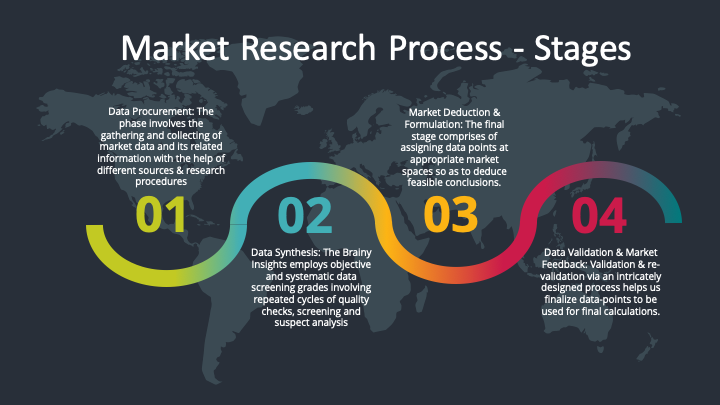
The phase involves the gathering and collecting of market data and its related information with the help of different sources & research procedures.
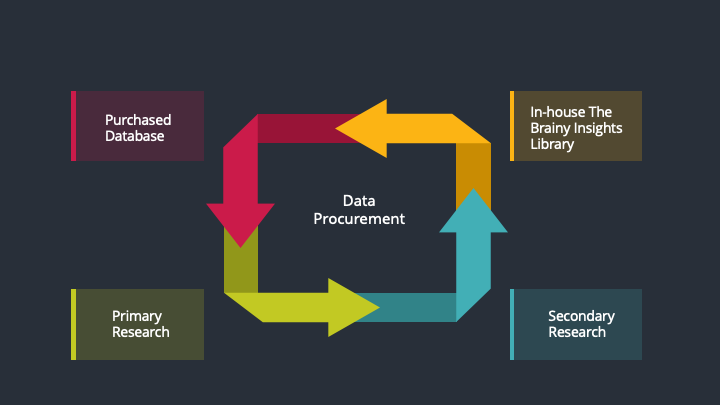
The data procurement stage involves in data gathering and collecting through various data sources.
This stage involves in extensive research. These data sources includes:
Purchased Database: Purchased databases play a crucial role in estimating the market sizes irrespective of the domain. Our purchased database includes:
Primary Research: The Brainy Insights interacts with leading companies and experts of the concerned domain to develop the analyst team’s market understanding and expertise. It improves and substantiates every single data presented in the market reports. Primary research mainly involves in telephonic interviews, E-mail interactions and face-to-face interviews with the raw material providers, manufacturers/producers, distributors, & independent consultants. The interviews that we conduct provides valuable data on market size and industry growth trends prevailing in the market. Our organization also conducts surveys with the various industry experts in order to gain overall insights of the industry/market. For instance, in healthcare industry we conduct surveys with the pharmacists, doctors, surgeons and nurses in order to gain insights and key information of a medical product/device/equipment which the customers are going to usage. Surveys are conducted in the form of questionnaire designed by our own analyst team. Surveys plays an important role in primary research because surveys helps us to identify the key target audiences of the market. Additionally, surveys helps to identify the key target audience engaged with the market. Our survey team conducts the survey by targeting the key audience, thus gaining insights from them. Based on the perspectives of the customers, this information is utilized to formulate market strategies. Moreover, market surveys helps us to understand the current competitive situation of the industry. To be precise, our survey process typically involve with the 360 analysis of the market. This analytical process begins by identifying the prospective customers for a product or service related to the market/industry to obtain data on how a product/service could fit into customers’ lives.
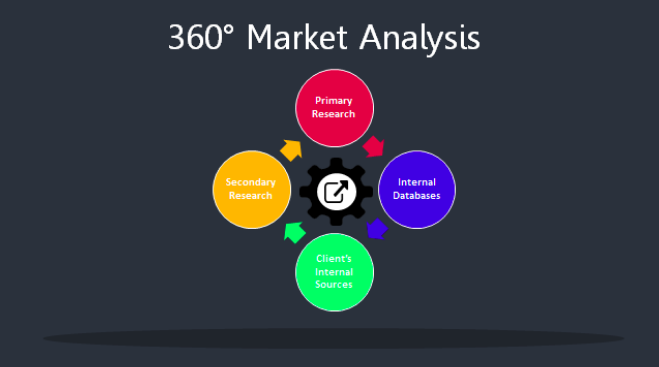
Secondary Research: The secondary data sources includes information published by the on-profit organizations such as World bank, WHO, company fillings, investor presentations, annual reports, national government documents, statistical databases, blogs, articles, white papers and others. From the annual report, we analyse a company’s revenue to understand the key segment and market share of that organization in a particular region. We analyse the company websites and adopt the product mapping technique which is important for deriving the segment revenue. In the product mapping method, we select and categorize the products offered by the companies catering to domain specific market, deduce the product revenue for each of the companies so as to get overall estimation of the market size. We also source data and analyses trends based on information received from supply side and demand side intermediaries in the value chain. The supply side denotes the data gathered from supplier, distributor, wholesaler and the demand side illustrates the data gathered from the end customers for respective market domain.
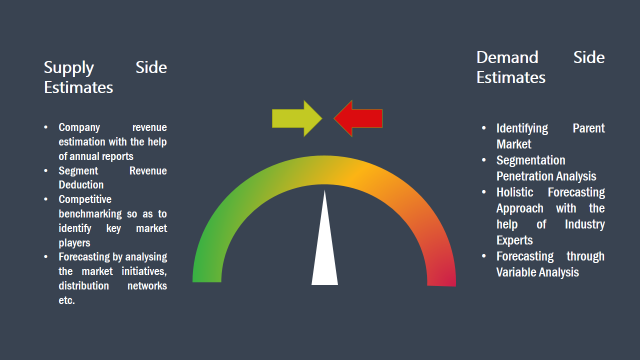
The supply side for a domain specific market is analysed by:
The demand side for the market is estimated through:
In-house Library: Apart from these third-party sources, we have our in-house library of qualitative and quantitative information. Our in-house database includes market data for various industry and domains. These data are updated on regular basis as per the changing market scenario. Our library includes, historic databases, internal audit reports and archives.
Sometimes there are instances where there is no metadata or raw data available for any domain specific market. For those cases, we use our expertise to forecast and estimate the market size in order to generate comprehensive data sets. Our analyst team adopt a robust research technique in order to produce the estimates:
Data Synthesis: This stage involves the analysis & mapping of all the information obtained from the previous step. It also involves in scrutinizing the data for any discrepancy observed while data gathering related to the market. The data is collected with consideration to the heterogeneity of sources. Robust scientific techniques are in place for synthesizing disparate data sets and provide the essential contextual information that can orient market strategies. The Brainy Insights has extensive experience in data synthesis where the data passes through various stages:
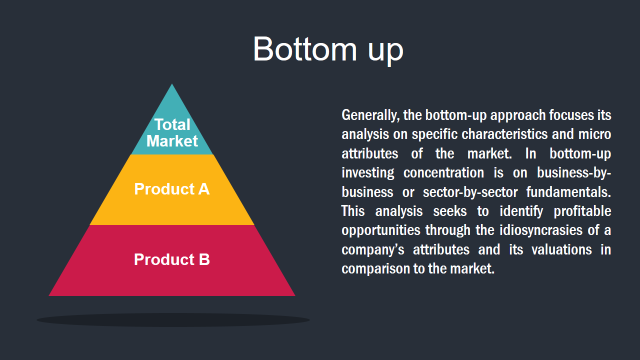
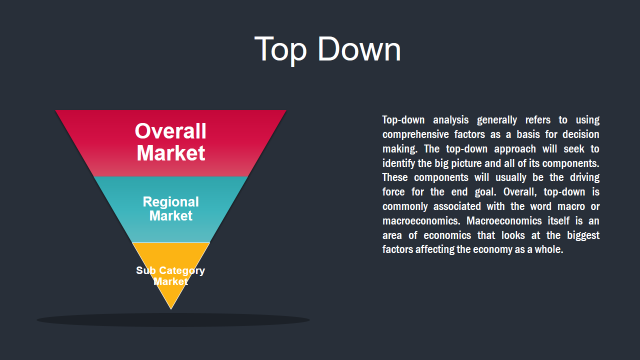
Market Deduction & Formulation: The final stage comprises of assigning data points at appropriate market spaces so as to deduce feasible conclusions. Analyst perspective & subject matter expert based holistic form of market sizing coupled with industry analysis also plays a crucial role in this stage.
This stage involves in finalization of the market size and numbers that we have collected from data integration step. With data interpolation, it is made sure that there is no gap in the market data. Successful trend analysis is done by our analysts using extrapolation techniques, which provide the best possible forecasts for the market.
Data Validation & Market Feedback: Validation is the most important step in the process. Validation & re-validation via an intricately designed process helps us finalize data-points to be used for final calculations.
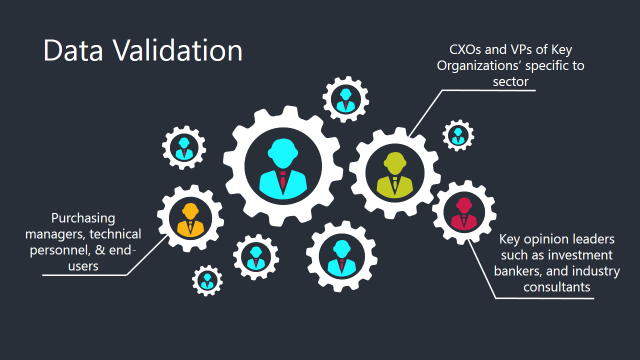
The Brainy Insights interacts with leading companies and experts of the concerned domain to develop the analyst team’s market understanding and expertise. It improves and substantiates every single data presented in the market reports. The data validation interview and discussion panels are typically composed of the most experienced industry members. The participants include, however, are not limited to:
Moreover, we always validate our data and findings through primary respondents from all the major regions we are working on.



















































Free Customization
Fortune 500 Clients
Free Yearly Update On Purchase Of Multi/Corporate License
Companies Served Till Date