- +1-315-215-1633
- sales@thebrainyinsights.com

The global digital twins for aircraft maintenance market was valued at USD 6 billion in 2024 and grew at a CAGR of 35% from 2025 to 2034. The market is expected to reach USD 120.63 billion by 2034. The rapid technological advancements will drive the growth of the global digital twins for aircraft maintenance market.
Digital twins for aircraft maintenance are digital representations (or twins) of physical airplanes or parts of them that are constantly updated with real-time information throughout the lifespan of the aircraft. Such digital twins combine information of different sources including sensors, operating records, maintenance records and environmental stipulations, allowing informed choices to be made through predictive maintenance. This concept of digital twins is revolutionizing the way that maintenance is being carried out in the aviation industry. Conventional maintenance practices usually comprise preplanned schedule maintenance or reactive maintenance that unnecessarily prolong unavailability of aircrafts. Predictive maintenance can be used to predetermine problems prior to their breakdown with the goal of saving on maintenance expenditure, increasing aircraft availability and safety. A digital twin records all the past, present and even future statuses of an aircraft or component. As an example, it can test how engines have been worn down, can estimate when parts will deteriorate in particular ways according to how they have been used, and can schedule the best time to make replacements or regular maintenance services. This not only enhances the forecast of the maintenance but also increases the life span of the major parts. Besides, digital twins contribute to the co-working of engineering, operations, and maintenance teams. The virtual model allows the engineers to test out various conditions or configurations without impacting the aircraft physically. It also helps it in compliance of regulation through being able to keep the record of the health as well as service history of the aircraft in the most minute of detail. In short, digital twins present a more intelligent, streamlined process of aircraft maintenance using advanced data analytics and in-real time data collection.
Get an overview of this study by requesting a free sample
The increasing need to reduce cost and enhance safety in the aviation industry – seeking improvement in the operational efficiency is one of the driving forces. Digital twins provide predictive analytics that benefit airlines and MRO (Maintenance, Repair, and Overhaul) organizations because they help to keep aircraft operation as minimal as possible and maximize time between maintenance. This is a transition between reactive and predictive maintenance that provides the possibility of tracking problems at the stage when interventions are still possible, and operations will run smoothly. Another very important driver is cost reduction. Therefore, a significant percentage of an airline operating cost is on maintenance. Digital twins can reduce maintenance expenses and maintain safety and reliability by predicting the component wear even better than it had been done before and avoiding unnecessary repairs and replacements. Besides that, organizations are more concerned with maximizing life of their high value assets. Digital twins help in more accurate tracking of part health and thus have better lifecycle management and get more accurate choices regarding part replacements and refurbishments. The additional support to the digital twin implementation process is provided by the increased accessibility of operational and performance data made possible by the on-board sensors and the IoT systems. Such an infrastructure in real-time data collection will be able to construct and support precise digital models. Finally, most airlines firms are integrating digital technologies in their long-term planning. Using digital twins is related to an overall objective of digital transition and keeping up in a competitive industry where maintenance is one of the areas to modernize and enhance data integration.
Cost, infrastructure and skilled professional – a high cost of implementation is one of the greatest impediments. The establishment and implementation of digital twin systems are costly in terms of investment in highly sophisticated sensors, data infrastructure, and software platforms, and human resources. They may be prohibitively expensive to many airlines and maintenance providers, particularly those that are much smaller. Other than the financial difficulty, there are usually insufficient skilled individuals to share their expertise in data science, artificial intelligence, and digital systems. Such talent shortage makes it difficult to develop, implement, and realize value on digital twin solutions. The other main constraint is the challenge that digital twins pose to existing IT and maintenance systems. Most companies in the aviation industry are still working on the old platforms that do not support the real-time data flow and analytics that digital twins would demand. Upgrading or replacing these systems can be complicated, take a lot of time, and be costly. Moreover, the successful application of digital twins strongly relies on good and stable data. As a matter of fact, a lack of cohesive data streams, data governance and data format inconsistency are faced among a number of organizations, which diminish the precision and dependability of the digital forms.
Technological advancements – among the key drivers is the growing pressure over the aviation sector by the regulatory bodies to uphold high standards of safety and adherence. Real-time monitoring of aircraft components and maintenance records can be achieved even at a detailed level, enhancing the ability of airlines to perform more successfully with what is expected of them in terms of meeting regulatory requirements and the cost-effective conduct of audits, which is why digital twins are so important. More than this, the growing air travel all around the world and the resulting growth in the size of fleets is forcing airlines into seeking the maintenance solutions that can be scaled and improved efficiently. Digital twins are becoming a de facto approach to maintenance as the size of fleets increases, and the methods of the past become unsustainable. There is increased pressure on airlines to mitigate their carbon footprints which also drives the market’s growth. The evolution of technology to address areas like AI, Internet of Things (IoT) and cloud computing has also increased production and availability of digital twin solutions, making it more accurate and cost-effective thereby enhancing its usage in the industry. Besides, the other factor is the competitive pressure which will drive the market’s growth.
The regions analyzed for the market include North America, Europe, South America, Asia Pacific, the Middle East, and Africa. North America emerged as the most significant global digital twins for aircraft maintenance market, with a 40% market revenue share in 2024.
The North American region is highly dominant in the global digital twins for aircraft maintenance market because of its well-established of aviation infrastructure, investments in the aircraft maintenance technologies, and position of major players in the industry. It is also an area with the largest aircraft manufacturers like Boeings and the principal airlines and MROs, all of which are already actively using the digital twin technology to become more efficient in their operations, safer, and cost conscious. This has meant that a very mature ecosystem of the major drivers has existed within which high use and growth of technology is achieved. Another feature that has pushed North America to the top is the fact that the region heavily focuses on innovation and the digital transformation. Predictive analytics, IoT, and AI have also been some of the technologies embraced early by airlines and MRO organizations in the U.S. and Canada, key technologies that are essential in digital twins. Other than that, there is also the regulatory environment, at least in North America, and specifically in the United States through the Federal Aviation Administration (FAA), is encouraging the use of advanced maintenance technologies that help increase safety and compliance. This has also encouraged the airlines and providers of maintenance to invest in digital twins so that they can meet expectations of the regulators more efficiently. Research and development have also been encouraged by the government and there is good interaction between the public and the private sector which has also helped to make the region pace setter.
North America Region Digital Twins for Aircraft Maintenance Market Share in 2024 - 40%
www.thebrainyinsights.com
Check the geographical analysis of this market by requesting a free sample
The component segment is divided into software, services and hardware. The software segment dominated the market, with a market share of around 40% in 2024. The software segment is the dominant category within the market regarding digital twins applied to aircraft maintenance worldwide because it is the foundation of facilitating the main functionalities of digital twin technology. Software is the core behind the digital twin systems where it enables the development, representation, simulation, and analysis of the virtual model of aircraft parts or the whole system. They are platforms where data collected by the different data sources, such as sensors, flight logs, and maintenance records are integrated to provide real-time insights and formulate predictive analytics. This functionality enables maintenance teams to keep an eye on the health of their aircraft, identify situations and predict failures of components long before they happen, greatly improving the effectiveness of maintenance and safety. The scalability and adaptability are one of the central factors that make software to dominate. In comparison with hardware that may require sophisticated installation and have physical limitations, the software solutions can be updated, customized, and scaled up to include more systems or fleet-wide activity relatively effortlessly. There is also the development of artificial intelligence (AI), machine learning and cloud computing which have further enhanced the capabilities of software to a greater extent creating more accurate models, high data processing speed and improved decision support tools. A variety of externality factors in digital twins maintain a constant presence of investments in cutting edge digital twin software, as the rising demand of data-driven maintenance and the increasing presence of predictive and condition-driven maintenance processes by the aviation industry drive demand. Software platforms that provide a seamless integration, user-friendly interfaces, and powerful analytics are currently given more attention by OEMs, airlines, and MROs.
The application segment is divided into predictive maintenance, fleet management and parts and engine monitoring. The predictive maintenance segment dominated the market, with a market share of around 38% in 2024. The segment with the most significant usage is predictive maintenance in the digital twins of aircraft maintenance market, as there will simply be a very positive shift in efficiency of operation, cost-saving, and safety following the application of this program. Conventional aviation methods of maintaining usually focus on pre-scheduled processes or reactive system that may lead to unwanted servicing of equipment or sudden breakdowns or unnecessarily prolonging the downtime of the aircraft. Digital twins have driven a change in this paradigm through predictive maintenance where data on real usage of components can be used to predict the health of a component in real-time. Digital twin software is used to simulate and analyse the wear, performance, and degradation of components using the data gathered by sensors embedded in different aircraft systems (e.g. engines, avionics, hydraulics and landing gear). This enables maintenance teams to keep ahead of the failures that may occur and carry out maintenance on as-needed basis hence making best use of resources and reducing the number of unscheduled repairs. The use of such a data-driven, condition-based maintenance concept can help lower the total maintenance costs, increase the life of current components, and make the aircraft more available. The increasing concentration of the aviation industry on safety and compliance along with the effectiveness of operations has contributed to the dominance of predictive maintenance as well. Airlines, as well as MROs, are also discovering how valuable predictive analytics can be to airworthiness in the most cost-effective way possible with regard to flight delays and cancellations affecting passengers. In addition, regulatory organizations endorse projects that make maintenance more transparent and traceable, which gives more weight to the implementation of predictive maintenance technologies. Its capacity to achieve reliability and cost-effective measures quickly, in a measurable way, guarantees its status quo in the use of the digital twin in aircraft maintenance.
The end user segment is divided into airlines, MRO providers and OEMs. The airlines segment dominated the market, with a market share of around 46% in 2024. Using large and complicated fleets, airlines are under permanent pressure to provide high aircraft availability, but with the lowest number of aircraft on the ground and the least interruptions to their operations. Digital twin technology provides a viable solution, where in real-time, monitoring, predictive maintenance, and data-driven decision-making processes are made available - all of which resonates with airline priorities. Using digital twins, airlines will be able to generate virtual copies of each of the aircraft, and key parts, which are updated in real-time with sensor data and maintenance histories. This enables maintenance crews to plan wear and failure, repair in advance and minimize unprogrammed groundings. The reliability increases the efficiency which in turn provides less maintenance costs, enhanced aircraft use, and improvement of conformance to flight schedules, which are all essential to profitability and customer satisfaction. Most large commercial carriers are combining the digital twin technology with the wider IT and maintenance platforms to develop the end-to-end digital maintenance systems. With sizeable fleets and a rapidly rising need in air travel all over the world, airlines are one of the dominant implementors of digital twins in the industry. The necessity to harmonize control of expenditures, safety and operational performance guarantees the long-term position that they will command in the digital twin ecosystem when it comes to the maintenance of aircraft.
| Attribute | Description |
|---|---|
| Market Size | Revenue (USD Billion) |
| Market size value in 2024 | USD 6 Billion |
| Market size value in 2034 | USD 120.63 Billion |
| CAGR (2025 to 2034) | 35% |
| Historical data | 2021-2023 |
| Base Year | 2024 |
| Forecast | 2025-2034 |
| Region | The regions analyzed for the market are Asia Pacific, Europe, South America, North America, and Middle East and Africa. Furthermore, the regions are further analyzed at the country level. |
| Segments | Component, Application and End User |
As per The Brainy Insights, the size of the global digital twins for aircraft maintenance market was valued at USD 6 billion in 2024 to USD 120.63 billion by 2034.
Global digital twins for aircraft maintenance market is growing at a CAGR of 35% during the forecast period 2025-2034.
The market's growth will be influenced by the increasing need to reduce cost and enhance safety in the aviation industry.
Cost, infrastructure and skilled professional could hamper the market growth.
This study forecasts revenue at global, regional, and country levels from 2021 to 2034. The Brainy Insights has segmented the global digital twins for aircraft maintenance market based on below mentioned segments:
Global Digital Twins for Aircraft Maintenance Market by Component:
Global Digital Twins for Aircraft Maintenance Market by Application:
Global Digital Twins for Aircraft Maintenance Market by End User:
Global Digital Twins for Aircraft Maintenance Market by Region:
Research has its special purpose to undertake marketing efficiently. In this competitive scenario, businesses need information across all industry verticals; the information about customer wants, market demand, competition, industry trends, distribution channels etc. This information needs to be updated regularly because businesses operate in a dynamic environment. Our organization, The Brainy Insights incorporates scientific and systematic research procedures in order to get proper market insights and industry analysis for overall business success. The analysis consists of studying the market from a miniscule level wherein we implement statistical tools which helps us in examining the data with accuracy and precision.
Our research reports feature both; quantitative and qualitative aspects for any market. Qualitative information for any market research process are fundamental because they reveal the customer needs and wants, usage and consumption for any product/service related to a specific industry. This in turn aids the marketers/investors in knowing certain perceptions of the customers. Qualitative research can enlighten about the different product concepts and designs along with unique service offering that in turn, helps define marketing problems and generate opportunities. On the other hand, quantitative research engages with the data collection process through interviews, e-mail interactions, surveys and pilot studies. Quantitative aspects for the market research are useful to validate the hypotheses generated during qualitative research method, explore empirical patterns in the data with the help of statistical tools, and finally make the market estimations.
The Brainy Insights offers comprehensive research and analysis, based on a wide assortment of factual insights gained through interviews with CXOs and global experts and secondary data from reliable sources. Our analysts and industry specialist assume vital roles in building up statistical tools and analysis models, which are used to analyse the data and arrive at accurate insights with exceedingly informative research discoveries. The data provided by our organization have proven precious to a diverse range of companies, facilitating them to address issues such as determining which products/services are the most appealing, whether or not customers use the product in the manner anticipated, the purchasing intentions of the market and many others.
Our research methodology encompasses an idyllic combination of primary and secondary initiatives. Key phases involved in this process are listed below:
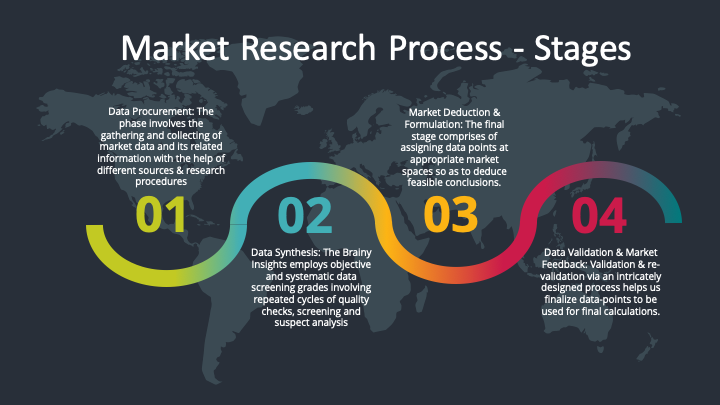
The phase involves the gathering and collecting of market data and its related information with the help of different sources & research procedures.
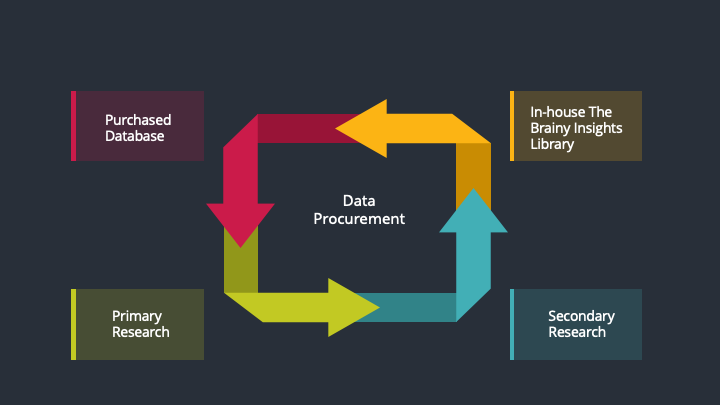
The data procurement stage involves in data gathering and collecting through various data sources.
This stage involves in extensive research. These data sources includes:
Purchased Database: Purchased databases play a crucial role in estimating the market sizes irrespective of the domain. Our purchased database includes:
Primary Research: The Brainy Insights interacts with leading companies and experts of the concerned domain to develop the analyst team’s market understanding and expertise. It improves and substantiates every single data presented in the market reports. Primary research mainly involves in telephonic interviews, E-mail interactions and face-to-face interviews with the raw material providers, manufacturers/producers, distributors, & independent consultants. The interviews that we conduct provides valuable data on market size and industry growth trends prevailing in the market. Our organization also conducts surveys with the various industry experts in order to gain overall insights of the industry/market. For instance, in healthcare industry we conduct surveys with the pharmacists, doctors, surgeons and nurses in order to gain insights and key information of a medical product/device/equipment which the customers are going to usage. Surveys are conducted in the form of questionnaire designed by our own analyst team. Surveys plays an important role in primary research because surveys helps us to identify the key target audiences of the market. Additionally, surveys helps to identify the key target audience engaged with the market. Our survey team conducts the survey by targeting the key audience, thus gaining insights from them. Based on the perspectives of the customers, this information is utilized to formulate market strategies. Moreover, market surveys helps us to understand the current competitive situation of the industry. To be precise, our survey process typically involve with the 360 analysis of the market. This analytical process begins by identifying the prospective customers for a product or service related to the market/industry to obtain data on how a product/service could fit into customers’ lives.
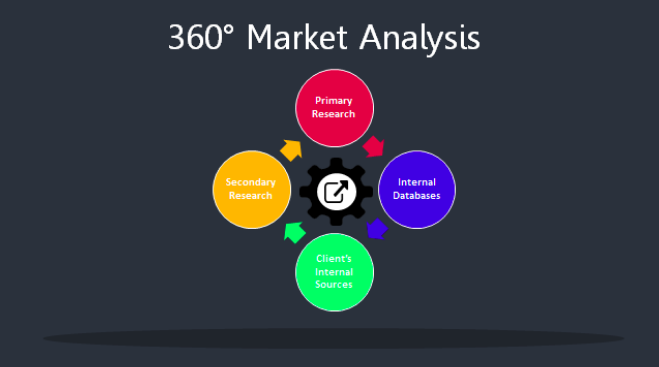
Secondary Research: The secondary data sources includes information published by the on-profit organizations such as World bank, WHO, company fillings, investor presentations, annual reports, national government documents, statistical databases, blogs, articles, white papers and others. From the annual report, we analyse a company’s revenue to understand the key segment and market share of that organization in a particular region. We analyse the company websites and adopt the product mapping technique which is important for deriving the segment revenue. In the product mapping method, we select and categorize the products offered by the companies catering to domain specific market, deduce the product revenue for each of the companies so as to get overall estimation of the market size. We also source data and analyses trends based on information received from supply side and demand side intermediaries in the value chain. The supply side denotes the data gathered from supplier, distributor, wholesaler and the demand side illustrates the data gathered from the end customers for respective market domain.
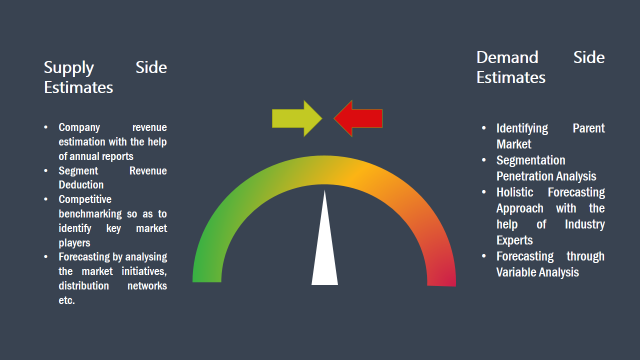
The supply side for a domain specific market is analysed by:
The demand side for the market is estimated through:
In-house Library: Apart from these third-party sources, we have our in-house library of qualitative and quantitative information. Our in-house database includes market data for various industry and domains. These data are updated on regular basis as per the changing market scenario. Our library includes, historic databases, internal audit reports and archives.
Sometimes there are instances where there is no metadata or raw data available for any domain specific market. For those cases, we use our expertise to forecast and estimate the market size in order to generate comprehensive data sets. Our analyst team adopt a robust research technique in order to produce the estimates:
Data Synthesis: This stage involves the analysis & mapping of all the information obtained from the previous step. It also involves in scrutinizing the data for any discrepancy observed while data gathering related to the market. The data is collected with consideration to the heterogeneity of sources. Robust scientific techniques are in place for synthesizing disparate data sets and provide the essential contextual information that can orient market strategies. The Brainy Insights has extensive experience in data synthesis where the data passes through various stages:
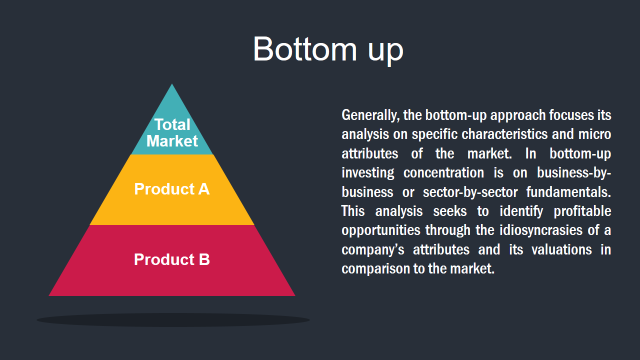
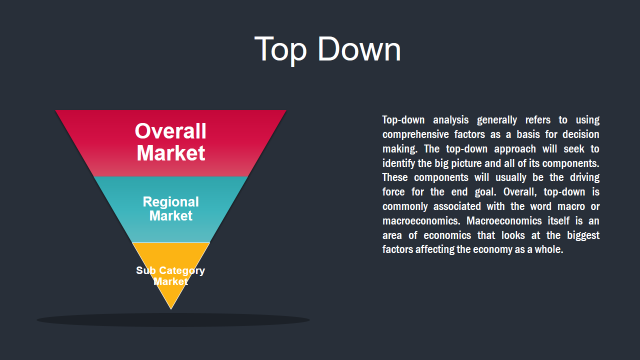
Market Deduction & Formulation: The final stage comprises of assigning data points at appropriate market spaces so as to deduce feasible conclusions. Analyst perspective & subject matter expert based holistic form of market sizing coupled with industry analysis also plays a crucial role in this stage.
This stage involves in finalization of the market size and numbers that we have collected from data integration step. With data interpolation, it is made sure that there is no gap in the market data. Successful trend analysis is done by our analysts using extrapolation techniques, which provide the best possible forecasts for the market.
Data Validation & Market Feedback: Validation is the most important step in the process. Validation & re-validation via an intricately designed process helps us finalize data-points to be used for final calculations.
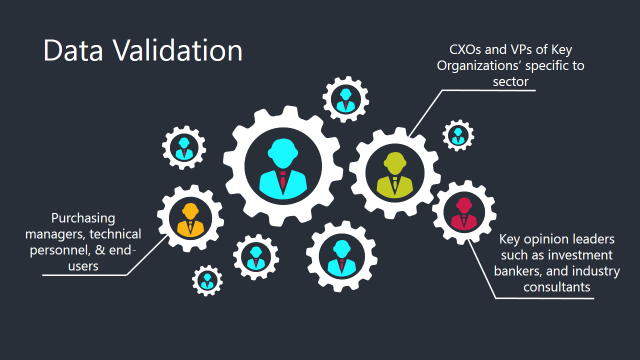
The Brainy Insights interacts with leading companies and experts of the concerned domain to develop the analyst team’s market understanding and expertise. It improves and substantiates every single data presented in the market reports. The data validation interview and discussion panels are typically composed of the most experienced industry members. The participants include, however, are not limited to:
Moreover, we always validate our data and findings through primary respondents from all the major regions we are working on.



















































Free Customization
Fortune 500 Clients
Free Yearly Update On Purchase Of Multi/Corporate License
Companies Served Till Date