- +1-315-215-1633
- sales@thebrainyinsights.com

The global blockchain in food supply chain market was valued at USD 3 billion in 2024 and grew at a CAGR of 23% from 2025 to 2034. The market is expected to reach USD 23.77 billion by 2034. The increasing demand for transparency in food supply chain by consumers will drive the growth of the global blockchain in food supply chain market.
Blockchain in food supply chain is the use of distributed ledger technology (DLT) to increase visibility, traceability, and confidence throughout the food chain, including all its steps from farm to fork. The classic food systems chain tends to be disintegrated thus prone to inefficiencies, visibility and risk of frauds or contamination. Blockchain solves these problems by providing an entity with secure and decentralized digital records that record all transactions and movements of the food products irrespective of place and time. All the actors within the chain of blockchain can add information like produce source, date of harvest, storage facility and means of transport, quality testing work. Such records when checked and included to the blockchain cannot be manipulated or erased hence providing a tamper evidence history of the product. It increases traceability if a food safety problem occurs, the block chain will enable the stakeholders to trace the source and affected batches quickly which will make recalling faster and reduce risks to the general population. In addition, blockchain enhances accountability and transparency. QR codes will be placed in food packaging and allow consumers to track the exact history of the product and its authenticity. To the producers and the retailers, it helps save on losses, avoid counterfeiting, and better meet regulations. It has the added benefit of enhancing ethical sourcing, as through this it checks certifications, i.e., organic, fair trade, or sustainable farming practices. Some of the giants such as food trust of IBM and Walmart have already made use of the blockchain application to track products such as lettuce and pork which has cut down the traceability time to months to seconds. Nevertheless, there still exist the problems of data standardization, reconnection with the legacy systems, and digital literacy of stakeholders. Nevertheless, blockchain is already becoming the revolutionary aspect of the food supply chain as it provides a safer, more efficient, and consumer-trust-focused environment that is beneficial to all parties.
Get an overview of this study by requesting a free sample
The increasing need for transparency in food supply chain – food manufacturers are demanding more traceability to track the place of origin, transportation and flow of food products with more precision. The other important aspect is the need to seek operational efficiency and a cut in cost. Manual record keeping, paperwork and duplication processes often stall traditional food supply systems. Blockchain takes over these missions and lowers the labour cost and improves inventory management. Firms also identify the importance of blockchain in protection and improvement of brand reputation. Business enterprises offer transparency and ensure consumers trust in their products and services through verifiable data by clearly setting out their sourcing and quality checks. This is a strategy that will enable the firm to differentiate themselves in a highly competitive market. It is particularly useful in cases when brands focus on the theme of sustainability, organic crops, or responsible sourcing. Also, blockchain can easily fit into other digital applications such as IoT devices, AI and RFID technology thus increases the whole digital environment. This compatibility enables companies to get the full value of their existing infrastructure and at the same time implement a future-ready solution.
High costs of implementation – the high cost of implementation is one of the most significant barriers. The incorporation of blockchain network demands high investment in digital infrastructure, software customization and employee training that could be burdensome to the small and medium-sized enterprises. Many companies also do not actually have the technical expertise in-sourced to run and service such systems, which results in further cost of dependency on third-party vendors and makes operations to be more complicated. The second important factor is trust in the data input. Blockchain has the advantage of ensuring that once information is recorded it cannot be tampered with hence authenticity of the initial information is not verifiable. This implies that wrong/fake reporting does not fade out of the ledger and may not hold any confidence and fail the intention of being transparent. Moreover, the traditional participants of supply chain, most of whom are used to old systems or manual systems, are resistant to change. The move towards a digital and decentralized system can be perceived as too disruptive or complex, particularly when it involves sharing of data with a competitor or a third party. There are also integration issues that restrict adoption. This difficulty in smooth interconnection adds more obstacles and extends the time of implementation.
Regulatory pressure – the modern-day consumer is more aware of what he or she consumes, what the source of the same is, how ethically and environmentally friendly the source is. Blockchain helps companies to address these expectations through providing auditable information about sourcing, processing and distribution, creating more trust and brand loyalty. Strict regulatory systems are also on the rise where governments and international organizations push stricter requirements on traceability and requirements concerning food safety standards. Using blockchain is a strong measure to track the movement of the products and checks the quality in real-time with the help of which a company can be compliant to be free of penalties levied on them. Additionally, since food fraud and counterfeiting are getting international attention, particularly in high-value commodities, such as organic vegetables, seafood, and meat, blockchain offers a secure system of product-level authentication to mitigate possible contamination. Another key is globalization of the supply chain generating complexity and necessitating enhanced coordination of the stakeholders. Blockchain enables real-time information sharing among the various geographies and entities with enhanced clarity and decision-making. Also, partnerships of major industries, like IBM Food Trust and activities of large retailers, stimulate blockchain adoption through evidence of practical benefits to organisations and lowering the threshold of entry due to technological solutions.
The regions analyzed for the market include North America, Europe, South America, Asia Pacific, the Middle East, and Africa. North America emerged as the most significant global blockchain in food supply chain market, with a 38% market revenue share in 2024.
North America dominates the blockchain in food supply chain market due to early adoption of technology and well-established regulatory systems and presence of large players in the market. The area especially the United States has been on the frontline when it comes to incorporation of blockchain into food supply chain processes with the major corporations like Walmart, IBM, Nestle, and Cargill at the frontline. One of the reasons why North America stood as one of the dominant markets is its food safety standards and growing pressure on the companies to be transparent, compliant and traceable. U.S. Food and Drug Administration (FDA) in its Food Safety Modernization Act (FSMA) is promoting the implementation of new technologies such as blockchain to avoid contamination so that timely and targeted recalls can be made. Moreover, North America is supported by a sufficiently developed infrastructure in the digital environment and by the great consumers and business awareness of the significance of food provenance, sustainability and ethical sourcing. This has amplified the need of blockchain services that give verifiable in real-time data on the origin, handling and quality of food. Suppliers in the region are also numerous blockchain startups and technologies suppliers and they enable innovation and collaboration along the supply chain.
North America Region Blockchain in Food Supply Chain Market Share in 2024 - 38%
www.thebrainyinsights.com
Check the geographical analysis of this market by requesting a free sample
The application segment is divided into traceability, smart contracts, payment & settlement, compliance management, risk & fraud management and inventory monitoring. The traceability segment dominated the market, with a market share of around 36% in 2024. The blockchain in food supply chain market is highly dominated by traceability application segment because of the increasing requirements of transparency, food safety, and quick responses in case of some contamination. The conventional forms of record keeping are disjointed, error-prone, and in most cases, these methods fail to offer real time updates. Blockchain helps to patch these vulnerabilities by recording every transaction and flow of food products along the supply chain on a decentralized tamper-proof ledger, which makes traceability more precise, effective, and safe. The increasing number of scandals and recalls regarding food safety in the world makes traceability one of the main reasons behind its predominance. In the case of blockchain, companies can trace the source of contamination and quarantine damaged stocks faster and conduct specific recalls faster which minimizes threats to public health and economic losses. Moreover, traceability can contribute to reliability with the growing regulations standards introduced by the governments and food safety agencies across the world. Customers also are seeking more information concerning what they eat, where it comes and how to make them more sustainable and ethical. This information is available to the end-user with the help of traceability based on blockchain recognition using QR codes or digital labels, which fundamentally builds trust and brand loyalty. In addition, traceability is of benefit to all the parties involved in the supply chain, i.e. farmers, manufacturers, logistics providers, and retailers because traceability will reduce conflicts, limit fraud and improve accountability.
The stakeholder segment is divided into growers, processors, distributors, retailers, food manufacturers and logistics providers. The retailers segment dominated the market, with a market share of around 35% in 2024. The most powerful stakeholders in blockchain in food supply chain market are retailers since they are in direct contact with their consumers and their importance at the end of the production chain. The retailers, in contrast to any other participant, are under tremendous pressure to make sure the products sold through them are of high quality, safe and free of scandals (contamination or mislabelling, naming various forms of fraud). To reduce these risks and increase the confidence of the customers, retailers have taken the front seat toward blockchain adoption in the food industry. Major retail players like Walmart, Carrefour and Albertsons have adopted a blockchain-based traceability model to track and confirm the source, treatment and state of food commodities. Besides, retailers have access to increased consumer pressure to ethically source products, be sustainable, and authenticate their products, a benefit that is provided by blockchain. With the help of blockchain, the retailers will be able to provide their customers with direct access to the specific details of product history through QR code, without reducing transparency and increase customer involvement.
The provider type segment is divided into application providers, middleware providers and infrastructure providers. The application providers segment dominated the market, with a market share of around 40% in 2024. The strongest players in the blockchain within food supply chain market are the application providers mainly because they are the entities providing the most essential platforms and applications which facilitate traceability, transparency, compliance, and automation within the food organize. These providers create the user-friendly interface and customizable applications based on blockchain technology that respond to the exclusive needs of a stakeholder like retailers, manufacturers, and the logistics company. They play a pivotal part in converting the intricate world behind the blockchain technology to materials that are accessible, scalable, and executable that can be added within the current supply chain processes. The application providers are dominant since they do not just deliver value through their technological gadgets but also by provision of support services such as implementation, maintenance and training. They also offer customized solutions to the different end-use industries such as meat, seafood, dairy, and fresh produce, thus increasing their market appeal. In addition, they actively collaborate with large grocery chains and food companies multiplying their power in the supply chain.
The end-use industry segment is divided into meat & seafood, dairy, fruits & vegetables, beverages, processed foods and others. The meat & seafood segment dominated the market, with a share of around 33% in 2024. These are very perishable products that involve high maintenance of cold chain, good handling and documentation at the source and up to the final consumer. The inability to ensure these circumstances may entail serious health hazards, governmental sanctions, and corporate image loss by the suppliers and retailers. Blockchain is a suggestive solution that allows a real-time trace of the temperature, storage conditions, and headship, which guarantees the safety and quality of the product. Meat and seafood market also experience fraud in terms of mislabelling, adulteration, and substitution of food. With the seal of Blockchain, it keeps a record of all parts of the path to certify the selling purity of products; it traces the product journey, whether it is getting fished or slaughtered, processed and packaged, or delivered. This tamper-proof information promotes consumer confidence and enables the regulatory agencies to make sure that they are observing food safety standards. In addition, the increased awareness related to consumers concerning the ethical origin and sustainability of meat and seafood products, has compelled firms to turn to blockchain to enhance visibility.
| Attribute | Description |
|---|---|
| Market Size | Revenue (USD Billion) |
| Market size value in 2024 | USD 3 Billion |
| Market size value in 2034 | USD 23.77 Billion |
| CAGR (2025 to 2034) | 23% |
| Historical data | 2021-2023 |
| Base Year | 2024 |
| Forecast | 2025-2034 |
| Region | The regions analyzed for the market are Asia Pacific, Europe, South America, North America, and Middle East and Africa. Furthermore, the regions are further analyzed at the country level. |
| Segments | Application, Stakeholder, Provider Type and End-Use Industry |
As per The Brainy Insights, the size of the global blockchain in food supply chain market was valued at USD 3 billion in 2024 to USD 23.77 billion by 2034.
Global blockchain in food supply chain market is growing at a CAGR of 23% during the forecast period 2025-2034.
The market's growth will be influenced by the increasing need for transparency in food supply chain.
High costs of implementation could hamper the market growth.
This study forecasts revenue at global, regional, and country levels from 2021 to 2034. The Brainy Insights has segmented the global blockchain in food supply chain market based on below mentioned segments:
Global Blockchain in Food Supply Chain Market by Application:
Global Blockchain in Food Supply Chain Market by Stakeholder:
Global Blockchain in Food Supply Chain Market by Provider Type:
Global Blockchain in Food Supply Chain Market by End-Use Industry:
Global Blockchain in Food Supply Chain Market by Region:
Research has its special purpose to undertake marketing efficiently. In this competitive scenario, businesses need information across all industry verticals; the information about customer wants, market demand, competition, industry trends, distribution channels etc. This information needs to be updated regularly because businesses operate in a dynamic environment. Our organization, The Brainy Insights incorporates scientific and systematic research procedures in order to get proper market insights and industry analysis for overall business success. The analysis consists of studying the market from a miniscule level wherein we implement statistical tools which helps us in examining the data with accuracy and precision.
Our research reports feature both; quantitative and qualitative aspects for any market. Qualitative information for any market research process are fundamental because they reveal the customer needs and wants, usage and consumption for any product/service related to a specific industry. This in turn aids the marketers/investors in knowing certain perceptions of the customers. Qualitative research can enlighten about the different product concepts and designs along with unique service offering that in turn, helps define marketing problems and generate opportunities. On the other hand, quantitative research engages with the data collection process through interviews, e-mail interactions, surveys and pilot studies. Quantitative aspects for the market research are useful to validate the hypotheses generated during qualitative research method, explore empirical patterns in the data with the help of statistical tools, and finally make the market estimations.
The Brainy Insights offers comprehensive research and analysis, based on a wide assortment of factual insights gained through interviews with CXOs and global experts and secondary data from reliable sources. Our analysts and industry specialist assume vital roles in building up statistical tools and analysis models, which are used to analyse the data and arrive at accurate insights with exceedingly informative research discoveries. The data provided by our organization have proven precious to a diverse range of companies, facilitating them to address issues such as determining which products/services are the most appealing, whether or not customers use the product in the manner anticipated, the purchasing intentions of the market and many others.
Our research methodology encompasses an idyllic combination of primary and secondary initiatives. Key phases involved in this process are listed below:
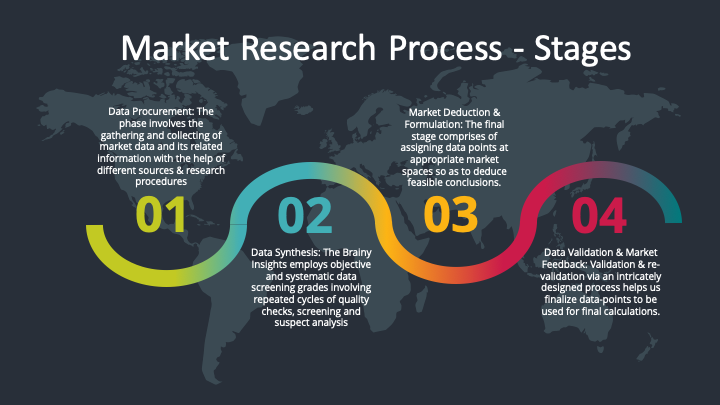
The phase involves the gathering and collecting of market data and its related information with the help of different sources & research procedures.
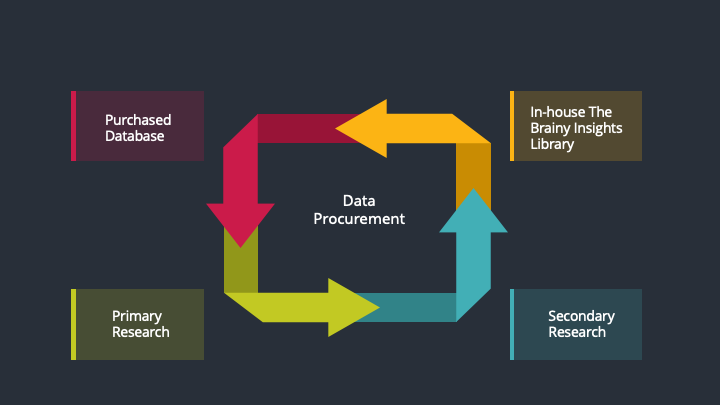
The data procurement stage involves in data gathering and collecting through various data sources.
This stage involves in extensive research. These data sources includes:
Purchased Database: Purchased databases play a crucial role in estimating the market sizes irrespective of the domain. Our purchased database includes:
Primary Research: The Brainy Insights interacts with leading companies and experts of the concerned domain to develop the analyst team’s market understanding and expertise. It improves and substantiates every single data presented in the market reports. Primary research mainly involves in telephonic interviews, E-mail interactions and face-to-face interviews with the raw material providers, manufacturers/producers, distributors, & independent consultants. The interviews that we conduct provides valuable data on market size and industry growth trends prevailing in the market. Our organization also conducts surveys with the various industry experts in order to gain overall insights of the industry/market. For instance, in healthcare industry we conduct surveys with the pharmacists, doctors, surgeons and nurses in order to gain insights and key information of a medical product/device/equipment which the customers are going to usage. Surveys are conducted in the form of questionnaire designed by our own analyst team. Surveys plays an important role in primary research because surveys helps us to identify the key target audiences of the market. Additionally, surveys helps to identify the key target audience engaged with the market. Our survey team conducts the survey by targeting the key audience, thus gaining insights from them. Based on the perspectives of the customers, this information is utilized to formulate market strategies. Moreover, market surveys helps us to understand the current competitive situation of the industry. To be precise, our survey process typically involve with the 360 analysis of the market. This analytical process begins by identifying the prospective customers for a product or service related to the market/industry to obtain data on how a product/service could fit into customers’ lives.
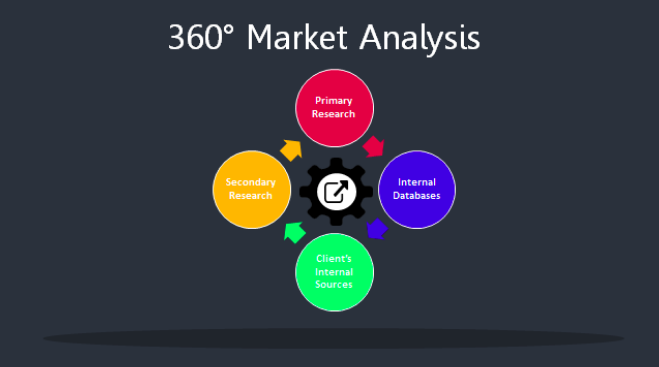
Secondary Research: The secondary data sources includes information published by the on-profit organizations such as World bank, WHO, company fillings, investor presentations, annual reports, national government documents, statistical databases, blogs, articles, white papers and others. From the annual report, we analyse a company’s revenue to understand the key segment and market share of that organization in a particular region. We analyse the company websites and adopt the product mapping technique which is important for deriving the segment revenue. In the product mapping method, we select and categorize the products offered by the companies catering to domain specific market, deduce the product revenue for each of the companies so as to get overall estimation of the market size. We also source data and analyses trends based on information received from supply side and demand side intermediaries in the value chain. The supply side denotes the data gathered from supplier, distributor, wholesaler and the demand side illustrates the data gathered from the end customers for respective market domain.
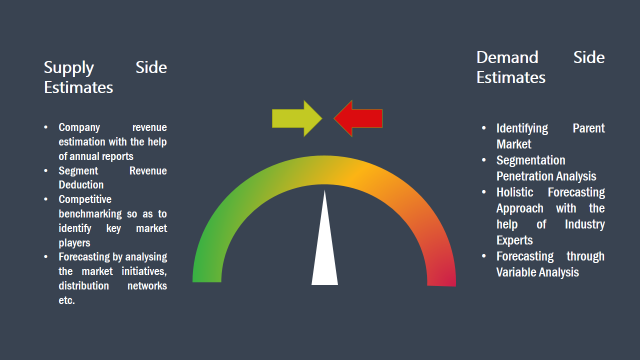
The supply side for a domain specific market is analysed by:
The demand side for the market is estimated through:
In-house Library: Apart from these third-party sources, we have our in-house library of qualitative and quantitative information. Our in-house database includes market data for various industry and domains. These data are updated on regular basis as per the changing market scenario. Our library includes, historic databases, internal audit reports and archives.
Sometimes there are instances where there is no metadata or raw data available for any domain specific market. For those cases, we use our expertise to forecast and estimate the market size in order to generate comprehensive data sets. Our analyst team adopt a robust research technique in order to produce the estimates:
Data Synthesis: This stage involves the analysis & mapping of all the information obtained from the previous step. It also involves in scrutinizing the data for any discrepancy observed while data gathering related to the market. The data is collected with consideration to the heterogeneity of sources. Robust scientific techniques are in place for synthesizing disparate data sets and provide the essential contextual information that can orient market strategies. The Brainy Insights has extensive experience in data synthesis where the data passes through various stages:
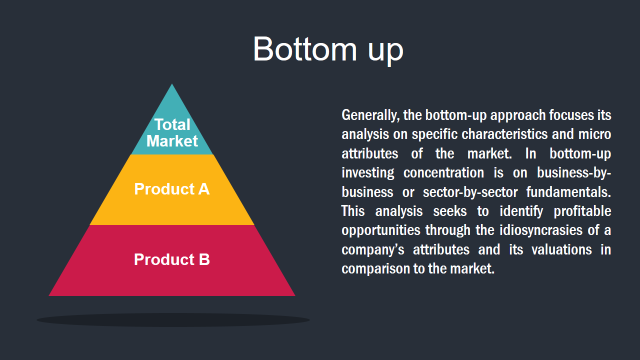
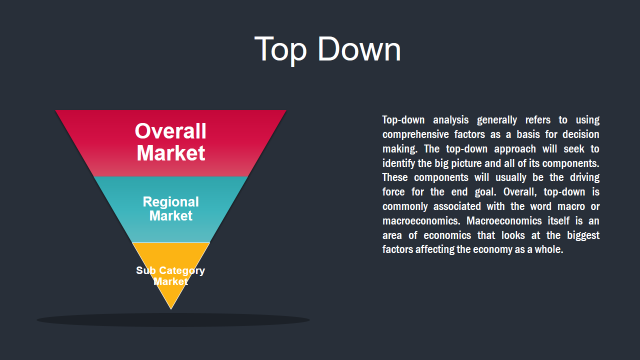
Market Deduction & Formulation: The final stage comprises of assigning data points at appropriate market spaces so as to deduce feasible conclusions. Analyst perspective & subject matter expert based holistic form of market sizing coupled with industry analysis also plays a crucial role in this stage.
This stage involves in finalization of the market size and numbers that we have collected from data integration step. With data interpolation, it is made sure that there is no gap in the market data. Successful trend analysis is done by our analysts using extrapolation techniques, which provide the best possible forecasts for the market.
Data Validation & Market Feedback: Validation is the most important step in the process. Validation & re-validation via an intricately designed process helps us finalize data-points to be used for final calculations.
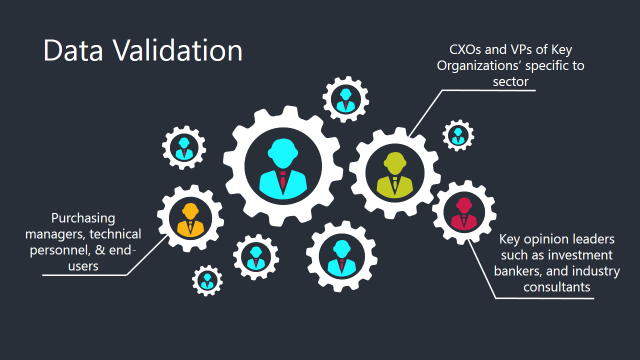
The Brainy Insights interacts with leading companies and experts of the concerned domain to develop the analyst team’s market understanding and expertise. It improves and substantiates every single data presented in the market reports. The data validation interview and discussion panels are typically composed of the most experienced industry members. The participants include, however, are not limited to:
Moreover, we always validate our data and findings through primary respondents from all the major regions we are working on.





































Free Customization
Fortune 500 Clients
Free Yearly Update On Purchase Of Multi/Corporate License
Companies Served Till Date