- +1-315-215-1633
- sales@thebrainyinsights.com

The global AI-powered air traffic management market was valued at USD 16 billion in 2024 and grew at a CAGR of 17% from 2025 to 2034. The market is expected to reach USD 76.90 billion by 2034. The increasing air traffic will drive the growth of the global AI-powered air traffic management market.
AI-powered air traffic maintenance are the processes of monitoring, regulation, and predictive air traffic maintenance with the help of artificial intelligence technologies. Historically, the air traffic control and aircraft maintenance has been using heavily manual activities, inspection schedules, and adopting reactive methods. But as air travel has increasingly become more complex, more efficient work has been required, and as a result, AI is being used to reinvent the process of maintenance and monitoring in the aircraft industry. Machine learning enables data-driven systems to prevent incidents by using mass amounts of data delivered through aircraft sensors, radar, and satellite tracking, as well as maintenance records to estimate possible malfunctions and disruption before they happen. With machine learning algorithms and real-time data analytics, such systems can identify changes in the performance of the aircraft and find anomalies that indicate wear and tear and can plan maintenance activities before they occur - avoiding expensive downtimes and improving safety in general. In air traffic management, AI may be used to allow optimization of flight paths and forecasting of potential peaks as well as helping in decision making in case of the emergencies. Such systems also have the potential to enhance usage of runways and minimize delays through the predictions of weather conditions as well as with predictive maintenance software. AI-powered air traffic maintenance is used to increase the efficiency of operations, boost equipment longevity, and incorporate flight safety, since it reduces the need to rely on routine checklists and respond to repairs as they happen.
Get an overview of this study by requesting a free sample
Technological advancements – the reactive-to-predictive-maintenance measures has become one of the most influential factors driving the adoption of AI-powered air traffic management. Conventional maintenance systems regularly depend on established timelines or after-failure treatments that cause unforeseen downtimes and have increased expenses. Predictive maintenance is a function associated with AI, where the real-time data of aircrafts that are tracked by sensors and systems is used to detect issues before they become serious and improve the availability and reliability of the aircrafts. The use of AI can simplify maintenance processes, minimize hardship, and mend resource distribution, each of which lowers maintenance cost. Improved safety is another aspect, which enhances the non-negotiable priority in the aviation industry, because of the potential of AI to predict faults in a timely manner, comply and perform improved monitoring. Digitalization of aviation operations offers a powerful data base that facilitates introducing AI. Such access to extensive operation data enables AI tools to provide more profound insights and immediate decision-making assistance. Besides, the air transportation industry is experiencing an acute lack of qualified maintenance staff, and automation and AI-driven support systems can be of great use to deal with routine checkups and complicated diagnostics. These technologies lessen reliance on human activities and increase the productivity of the workforce. The factors that are contributing to the growing number of AI-based solutions adoption in the industry include the growing importance of data-driven processes in this branch, which makes AI in maintenance processes even more critical to meet the performance, safety, and sustainability demands, making these factors a crucial part of the increased popularity of AI-based solutions.
High investments costs – there is a need to have high initial investment in the deployment of AI systems, which includes some cost of advanced sensors, data infrastructure, high-performance computing, and trained staff. Such financial needs cannot be justified by many small and mid-sized airlines and airports. Also, the aviation market is strongly dependent on legacy systems that cannot help to manage the modern AI-based systems. Combining the aging systems with AI is frequently fraught with major technical pains, as well as downtime, which serves as another discouragement. The other internal barrier is unsteady availability and quality of operational data. Certain planes or maintenance systems older systems have sensors or in-real-time monitoring, which is critical to assemble the amount and goodness of the mathematically possible data that AI models need to perform. In addition, the aviation industry staff is usually not technically qualified to help manage AI, machine learning and data analytics systems, and thus companies are not ready to engage in the management of such systems unless they are trained or hire third parties. There is also always the resistance to change since the industry is always quite conservative and risk-averse because it has high safety and regulatory systems.
Regulatory developments – among the factors that have continued to accelerate the progress of air travels around the world is the unending growth in the air traffic which has placed so much load on the current air traffic and air maintenance platforms. In an attempt to effectively handle this expansion, investors in the aviation sector are resorting to AI options that increase the scalability aspect and relieve the system. At the same time, the number of stringent regulatory requirements posed by the aviation organizations, including FAA and EASA, requires an increase in the levels of safety, reliability, and maintenance responsibility. Automating processes with AI technologies and enhanced accuracy in monitoring and reporting can assist airlines and airports to deal with emerging compliance standards. Also, there is growing pressure to ensure sustainable practice by the aviation industry to minimize its impact on the environment. The examples of AI contributions to these efforts include the optimization of flight paths, the minimization of the fuel consumption, as well as the provision of maintenance. Also, the technological efforts in the development of AI, machine learning, and computer vision are bringing adoption of the technologies due to their increased reliability, accessibility, and affordability of intelligent systems in the aviation industry.
The regions analyzed for the market include North America, Europe, South America, Asia Pacific, the Middle East, and Africa. North America emerged as the most significant global AI-powered air traffic management market, with a 35% market revenue share in 2024.
The region is home to some of the largest airlines as well as the fast-growing aerospace manufacturers and technology companies all of which boost the demand of advanced maintenance services. United States is a highly developed country with its aviation sector that boasts of a well-established infrastructure, government funding, effective regulations, and safety and operational efficiency. Specific agencies, such as the Federal Aviation Administration (FAA), especially advocate the modernization of air traffic systems to integrate AI technologies by means of research programs and public-private associations. Besides, North America also has a solid ecosystem of AI research and development with Silicon Valley and other major technology centres having access to talent, startups and innovation in machine learning, data analytics and cloud computing. Moreover, huge IoT and sensor networks in airplanes, as well as in air traffic control systems, create massive volumes of data, which can accelerate AI applications. Seamless integration with the cloud-based platform and advanced AI tools are also possible, which are made possible by the mature IT infrastructure and increased IT spending potential over the other regions.
North America Region AI-Powered Air Traffic Management Market Share in 2024 - 35%
www.thebrainyinsights.com
Check the geographical analysis of this market by requesting a free sample
The component segment is divided into hardware, software and services. The software segment dominated the market, with a market share of around 40% in 2024. The leading position of software in the international market of AI-based air traffic maintenance can be explained by its important role in the organization of intelligent, data-driven decision-making and efficiency in work. Such software solutions, in contrast to the hardware (IoT devices, sensors, etc.), do not merely store raw data but are built to consume enormous amounts of aviation data and analyse and process them using AI algorithms, machine learning models, predictive analytics platforms, and digital twin technologies. Software products help airlines, airports, and maintenance teams to use basic inputs, work out valuable business intelligence and be able to predict possible failures, plan optimal schedules and improve safety levels. The fact that the AI software can learn with continued time and make improving predictions set it to be an essential element in any predictive maintenance, fault detection, and condition-monitoring in real-time, which is the critical applications in the market. Additionally, the scalability and flexibility of software platforms are higher than those of hardware since they can be updated, or with new features implemented, without having to be changed physically, resulting in a shorter time and less cost to go down. The rising digitalization of the aviation industry, in general, including ever-greater IoT sensors and cloud computing, only adds to the need in powerful software systems capable of connecting various data sources in one seamless fashion. Software solutions are also packaged with easy-to-understand interfaces, reporting dashboards, and have integrations with the existing enterprise resource planning (ERP) or maintenance management systems, thus simple to use and run. That being the case, stakeholders are keen to invest in AI-enabled software to ensure the high output in operations and safety. The software innovation will be one of the driving forces that will propel its wide use in the AI-assisted air traffic maintenance market and has instilled confidence in the digital transformation of the sector to be promoted in the future.
The application segment is divided into predictive maintenance, condition monitoring, fault detection and diagnostics and air traffic management optimization. The predictive maintenance segment dominated the market, with a market share of around 35% in 2024. Predictive maintenance takes a leading position in the market of AI-based air traffic maintenance as it has the capacity to lead to the high reliability of aircraft, the decrease of operating costs, and the advancement of safety. Predictive maintenance enables airlines and maintenance teams to tackle problems before they arise. Predictive maintenance will also work out and streamline any unnecessary replacements because it uses less stock of parts and moves during repairs, saving a lot of cost. The aviation sector also pushes the rise of predictive maintenance, due to the strict safety regulation it subjects to its sector, where the identification of abnormalities in advance is sought to avoid any critical failure that may endanger the safety of passengers. Predictive maintenance reduces the cost of aircraft parts repair and maintenance by enhancing the life of the aircraft parts and decreasing inefficiency and waste in aviation through enabling movements towards time-based to condition-based maintenance.
The end-user segment is divided into airlines, airport authorities, maintenance, repair, and overhaul (MRO) providers and air traffic control organizations. The airlines segment dominated the market, with a market share of around 48% in 2024. The global AI-powered air traffic maintenance market runs with the dominance of airlines since they consist of the main end-users that directly enjoy the benefits of enhanced aircraft availability, safety, and operational effectiveness. Being the operators and the managers of large fleets, the airlines have a lot of reasons to reduce downtimes and delays, which may cost a lot of money and damage their image as well. Maintenance powered by AI mitigates the unforeseen maintenance lapse and streamlines the turnaround process, which is essential in keeping strict flight schedules and maximising aircrafts in service. Further, the costs of maintenance concerning the airlines involve man-hours, spares, and unscheduled maintenance. Airlines can save on these costs by using AI based analytics to eliminate wasteful maintenance and concentrate on needs at optimum priority. Modern aircraft have thousands of sensors that produce huge volumes of data, which is impractical to monitor manually; airlines depend largely on AI software as an efficient method to process this data. Moreover, airlines are highly regulated, and their safety must be very high, and to this end the role of AI to ensure such compliance and risk control is crucial. Although airports, organization of air traffic controllers, and providers of MRO use AI-based maintenance tools, they are the least demanded by them, as airlines have direct interests in the behaviour of aircraft operational and financial.
The deployment mode segment is divided into on-premises and cloud-based. The cloud-based segment dominated the market, with a share of around 67% in 2024. The presence of cloud-based deployment in the market of AI-powered maintenance of air traffic can be explained by the fact that this technology possesses an abundance of benefits compared to the traditional on-premises models of the same nature, especially with regards to scalability, affordability, and ease of access. The presence of cloud-based platforms allows the airlines, airports, and the maintenance providers to easily take advantage of the powerful AI and machine learning tools without having to massively invest in physical facilities. Such adaptability can support organizations with diverse sizes to implement the superior predictive maintenance and real-time monitoring functions without being required to deal with complex hardware and software on-premised. The cloud-based solutions also enable the integration of various data sources in the same plane- aircraft sensors to weather systems in one source, and storage and processing of large volumes of data in real time. This central data processing improves the accuracy and speed of AI driven analytics, making it possible to make faster data-driven decisions that will help increase operational efficiency and safety. The other outstanding benefit is that it is remotely accessible; the stakeholders in various locations such as maintenance workforces, engineers and air traffic controllers can access maintenance data and effectively share it in cloud portals or through mobile apps. Moreover, the cloud deployment helps to automatically update and constantly improve the AI algorithms without operator interventions and downtime periods. Because air traffic management is a dynamic process, such flexibility is essential. Security speeds, standards and responsiveness have also advanced greatly in cloud-based services to eliminate the previous issues of data privacy and cyber threats. And, as digitalization is increasingly becoming the trend in the aviation industry, and as companies are focused on cost-effective, scalable options, the cloud-based AI platforms have become the most popular solution, ensuring the leading position in the market of AI-driven air traffic maintenance.
| Attribute | Description |
|---|---|
| Market Size | Revenue (USD Billion) |
| Market size value in 2024 | USD 16 Billion |
| Market size value in 2034 | USD 76.90 Billion |
| CAGR (2025 to 2034) | 17% |
| Historical data | 2021-2023 |
| Base Year | 2024 |
| Forecast | 2025-2034 |
| Region | The regions analyzed for the market are Asia Pacific, Europe, South America, North America, and Middle East and Africa. Furthermore, the regions are further analyzed at the country level. |
| Segments | Component, Application, End-User and Deployment Mode |
As per The Brainy Insights, the size of the global AI-powered air traffic management market was valued at USD 16 billion in 2024 to USD 76.90 billion by 2034.
Global AI-powered air traffic management market is growing at a CAGR of 17% during the forecast period 2025-2034.
The market's growth will be influenced by technological advancements.
High investments costs could hamper the market growth.
This study forecasts revenue at global, regional, and country levels from 2021 to 2034. The Brainy Insights has segmented the global AI-powered air traffic management market based on below mentioned segments:
Global AI-Powered Air Traffic Management Market by Component:
Global AI-Powered Air Traffic Management Market by Application:
Global AI-Powered Air Traffic Management Market by End-User:
Global AI-Powered Air Traffic Management Market by Deployment Mode:
Global AI-Powered Air Traffic Management Market by Region:
Research has its special purpose to undertake marketing efficiently. In this competitive scenario, businesses need information across all industry verticals; the information about customer wants, market demand, competition, industry trends, distribution channels etc. This information needs to be updated regularly because businesses operate in a dynamic environment. Our organization, The Brainy Insights incorporates scientific and systematic research procedures in order to get proper market insights and industry analysis for overall business success. The analysis consists of studying the market from a miniscule level wherein we implement statistical tools which helps us in examining the data with accuracy and precision.
Our research reports feature both; quantitative and qualitative aspects for any market. Qualitative information for any market research process are fundamental because they reveal the customer needs and wants, usage and consumption for any product/service related to a specific industry. This in turn aids the marketers/investors in knowing certain perceptions of the customers. Qualitative research can enlighten about the different product concepts and designs along with unique service offering that in turn, helps define marketing problems and generate opportunities. On the other hand, quantitative research engages with the data collection process through interviews, e-mail interactions, surveys and pilot studies. Quantitative aspects for the market research are useful to validate the hypotheses generated during qualitative research method, explore empirical patterns in the data with the help of statistical tools, and finally make the market estimations.
The Brainy Insights offers comprehensive research and analysis, based on a wide assortment of factual insights gained through interviews with CXOs and global experts and secondary data from reliable sources. Our analysts and industry specialist assume vital roles in building up statistical tools and analysis models, which are used to analyse the data and arrive at accurate insights with exceedingly informative research discoveries. The data provided by our organization have proven precious to a diverse range of companies, facilitating them to address issues such as determining which products/services are the most appealing, whether or not customers use the product in the manner anticipated, the purchasing intentions of the market and many others.
Our research methodology encompasses an idyllic combination of primary and secondary initiatives. Key phases involved in this process are listed below:
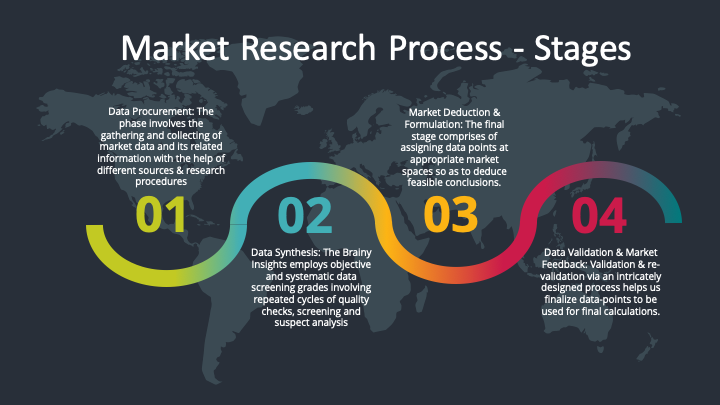
The phase involves the gathering and collecting of market data and its related information with the help of different sources & research procedures.
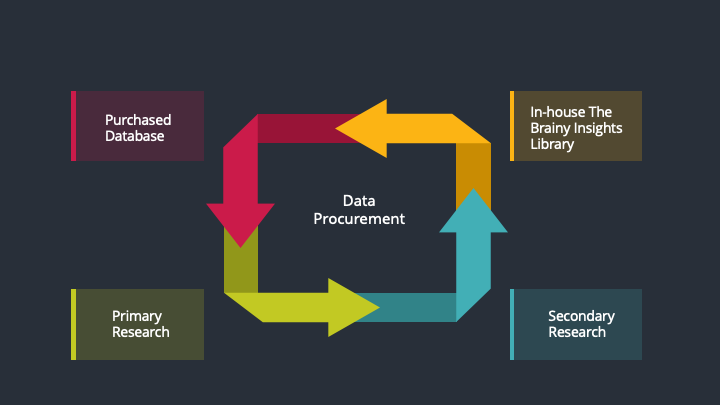
The data procurement stage involves in data gathering and collecting through various data sources.
This stage involves in extensive research. These data sources includes:
Purchased Database: Purchased databases play a crucial role in estimating the market sizes irrespective of the domain. Our purchased database includes:
Primary Research: The Brainy Insights interacts with leading companies and experts of the concerned domain to develop the analyst team’s market understanding and expertise. It improves and substantiates every single data presented in the market reports. Primary research mainly involves in telephonic interviews, E-mail interactions and face-to-face interviews with the raw material providers, manufacturers/producers, distributors, & independent consultants. The interviews that we conduct provides valuable data on market size and industry growth trends prevailing in the market. Our organization also conducts surveys with the various industry experts in order to gain overall insights of the industry/market. For instance, in healthcare industry we conduct surveys with the pharmacists, doctors, surgeons and nurses in order to gain insights and key information of a medical product/device/equipment which the customers are going to usage. Surveys are conducted in the form of questionnaire designed by our own analyst team. Surveys plays an important role in primary research because surveys helps us to identify the key target audiences of the market. Additionally, surveys helps to identify the key target audience engaged with the market. Our survey team conducts the survey by targeting the key audience, thus gaining insights from them. Based on the perspectives of the customers, this information is utilized to formulate market strategies. Moreover, market surveys helps us to understand the current competitive situation of the industry. To be precise, our survey process typically involve with the 360 analysis of the market. This analytical process begins by identifying the prospective customers for a product or service related to the market/industry to obtain data on how a product/service could fit into customers’ lives.
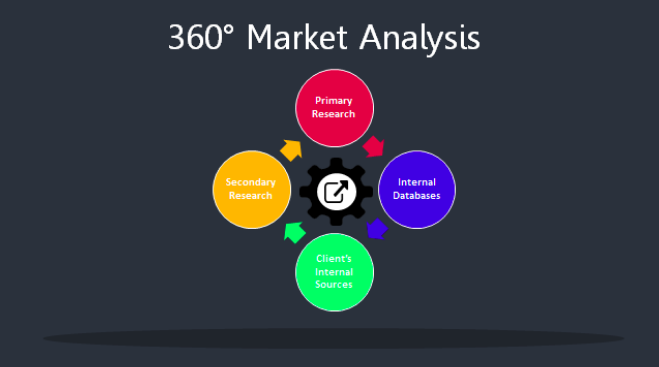
Secondary Research: The secondary data sources includes information published by the on-profit organizations such as World bank, WHO, company fillings, investor presentations, annual reports, national government documents, statistical databases, blogs, articles, white papers and others. From the annual report, we analyse a company’s revenue to understand the key segment and market share of that organization in a particular region. We analyse the company websites and adopt the product mapping technique which is important for deriving the segment revenue. In the product mapping method, we select and categorize the products offered by the companies catering to domain specific market, deduce the product revenue for each of the companies so as to get overall estimation of the market size. We also source data and analyses trends based on information received from supply side and demand side intermediaries in the value chain. The supply side denotes the data gathered from supplier, distributor, wholesaler and the demand side illustrates the data gathered from the end customers for respective market domain.
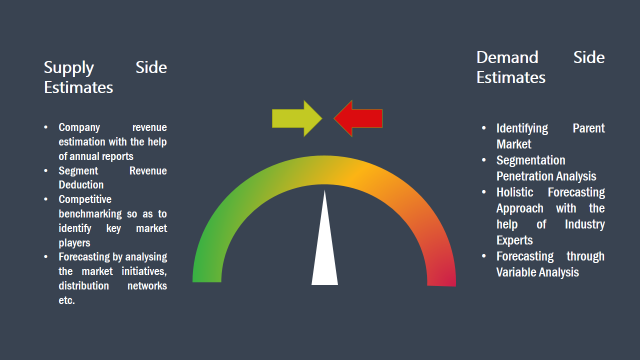
The supply side for a domain specific market is analysed by:
The demand side for the market is estimated through:
In-house Library: Apart from these third-party sources, we have our in-house library of qualitative and quantitative information. Our in-house database includes market data for various industry and domains. These data are updated on regular basis as per the changing market scenario. Our library includes, historic databases, internal audit reports and archives.
Sometimes there are instances where there is no metadata or raw data available for any domain specific market. For those cases, we use our expertise to forecast and estimate the market size in order to generate comprehensive data sets. Our analyst team adopt a robust research technique in order to produce the estimates:
Data Synthesis: This stage involves the analysis & mapping of all the information obtained from the previous step. It also involves in scrutinizing the data for any discrepancy observed while data gathering related to the market. The data is collected with consideration to the heterogeneity of sources. Robust scientific techniques are in place for synthesizing disparate data sets and provide the essential contextual information that can orient market strategies. The Brainy Insights has extensive experience in data synthesis where the data passes through various stages:
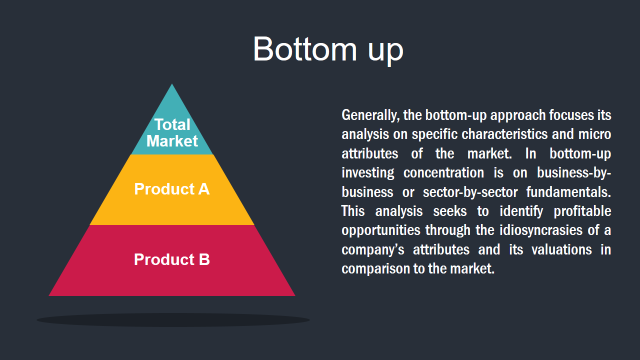
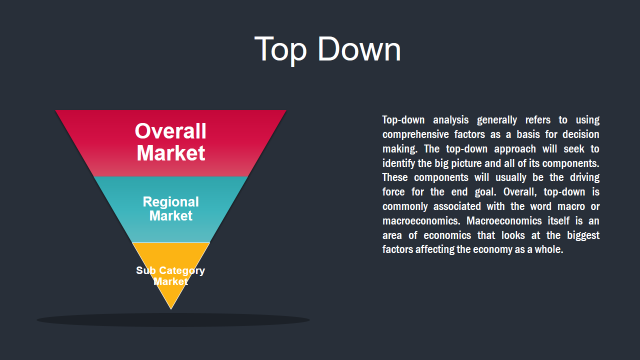
Market Deduction & Formulation: The final stage comprises of assigning data points at appropriate market spaces so as to deduce feasible conclusions. Analyst perspective & subject matter expert based holistic form of market sizing coupled with industry analysis also plays a crucial role in this stage.
This stage involves in finalization of the market size and numbers that we have collected from data integration step. With data interpolation, it is made sure that there is no gap in the market data. Successful trend analysis is done by our analysts using extrapolation techniques, which provide the best possible forecasts for the market.
Data Validation & Market Feedback: Validation is the most important step in the process. Validation & re-validation via an intricately designed process helps us finalize data-points to be used for final calculations.
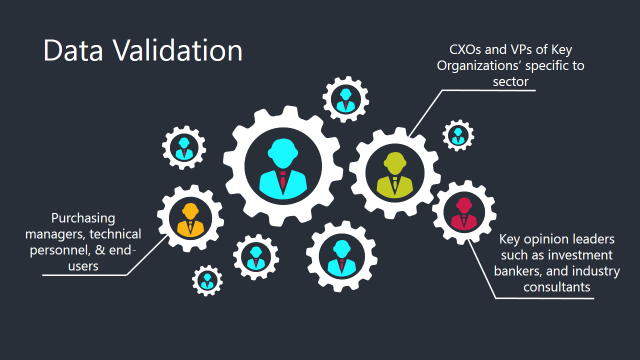
The Brainy Insights interacts with leading companies and experts of the concerned domain to develop the analyst team’s market understanding and expertise. It improves and substantiates every single data presented in the market reports. The data validation interview and discussion panels are typically composed of the most experienced industry members. The participants include, however, are not limited to:
Moreover, we always validate our data and findings through primary respondents from all the major regions we are working on.



















































Free Customization
Fortune 500 Clients
Free Yearly Update On Purchase Of Multi/Corporate License
Companies Served Till Date