- +1-315-215-1633
- sales@thebrainyinsights.com

The global advanced air mobility (AAM) market was valued at USD 12 billion in 2024 and grew at a CAGR of 21% from 2025 to 2034. The market is expected to reach USD 80.73 billion by 2034. The increasing urban congestion will drive the growth of the global advanced air mobility (AAM) market.
Advanced Air Mobility (AAM) is an aviation innovation concept that combines new technologies of aircraft, digital infrastructure and regulatory as well as moving people and products safely and sustainably over cities and even in rural areas. This new mobility scenario implies using electric or hybrid-electric vertical take-off and landing (eVTOL) aircraft, unmanned aerial vehicles (UAVs or drones), and other types of increasingly advanced aircraft that may have little or no requirement of runway infrastructure. AAM is supposed to be an addition to the current transportation systems and help decongest them, most especially in heavily populated cities and towns, and enhance access in the remote, or underdeveloped areas. The major parts of AAM are more advanced propulsion systems, batteries, lightweight materials, automated flight control, air traffic management system, and ground structure such as vertiports and charging systems. AAM includes an array of areas of operation including Urban Air Mobility (UAM), that is passenger or cargo transportation to distances of a few kilometres; Regional Air Mobility (RAM), passenger or cargo transportation to longer distances within cities or between cities; and autonomous drone cargo delivery, transport of medical supplies, and emergency rescue services. AAM is on the verge to reinvent air travel by having less environmental impact, fewer noise levels, and enhanced operational flexibility.
Get an overview of this study by requesting a free sample
Technological innovation and increasing investment in the industry – the upsurge in the core technologies like the electric propulsion system, high-density battery, autonomous flight, and lightweight composite materials are one of the key drivers. These developments have enhanced the performance as well as the efficiency and safety of electric vertical take-off and landing (eVTOL) aircraft and unmanned aerial vehicles (UAVs) and has made their commercial application all the more possible. At the same time, new entrants in the industry, including aerospace giants, technology startups, and automotive makers, have been escalating research and development-related operations in the AAM sector owing to strategic collaborations and investment schemes. This investment boom is fast-tracking prototyping, certification trials and launching test flights within city and regional corridors. Reduction in the price of electric aviation technologies, especially batteries and power management system is also augmenting the market’s growth. Such cost effectiveness increases the economic viability of AAM operations particularly in contrast to conventional rotorcraft aircraft.
Technological barriers and financial constraints – among the most common limiting factors include the immature state of technologies that will be needed to feed the vessel including high-density batteries, autonomous navigation systems, and electric propulsion technologies among others. Even though they are developed quite fast, lots of those systems remain at the development stages and cannot be used commercially at a large scale straight away. Short range, low transport capability and operation in situations with unfavourable weather negatively affect the practical use of AAM aircraft. Moreover, the development and production of advanced aircraft is expensive, as are the costs of erecting infrastructure to support vertiports and charge stations; both of which are huge financial impediments to competition, particularly among those firms who haven not gained a foothold in the industry yet. The other significant constraint is readiness of supporting infrastructure and systems. The cornerstone aspects such as the real-time air traffic management system customized to work on the low level, standardized charging systems, maintenance facilities are yet to be implemented. The security and consistency matters are also not solved.
Changing urban dynamics – among the most noticeable is the ever-growing congestion in most of the major cities in the world that have necessitated an urgent need of other alternative transport that is faster and more efficient. AAM is the answer because it will allow short-haul flights that would not run on conventional road networks and would hence greatly improve connectivity and travel time. Furthermore, the emergence of e-commerce and the need of providing fast last-mile delivery also increases the rate of implementation of drone-based logistics and cargo transportation, as AAM is appealing to companies with urgent and flexible delivery connection needs. Receptive policy moves and governmental support are equally making a significant impact. Organizations like the Federal Aviation Administration (FAA) and the European Union Aviation Safety Agency (EASA) are currently developing systems to enable AAM to merge with the current airspace framework, and numerous governments are investing in proof-of-concepts, studies, and groundwork. Another significant driver is the increasing focus towards controlling climate change. With the world demanding decarbonization in industries, AAM, through its electric and hybrid-electric planes, provides a clean and easy replacement of traditional transportation methods. In addition, the occurrence of a public health crisis, such as the COVID-19 pandemic, demonstrated the benefits of unmanned aerial vehicles to deliver medical supplies and respond to emergencies and further proved the feasibility of AAM.
The regions analyzed for the market include North America, Europe, South America, Asia Pacific, the Middle East, and Africa. North America emerged as the most significant global advanced air mobility (AAM) market, with a 40% market revenue share in 2024.
The United States, Canada, and Mexico form the largest global Advanced Air Mobility (AAM) market due to the synergy between technological leadership and supportive regulations and an excellent industry investment. The United States has particularly become the ground zero of AAM innovation, with several startups and larger aerospace companies busy working on electric vertical take-off and landing (eVTOL) aircraft, autonomous drones, and their supporting infrastructure. Joby Aviation, Archer Aviation, Wisk Aero, and Beta technologies are the best firms racing in the world to develop and test the AAM platforms that will be used to execute passengers and cargo transportation. Enhancing this bustling ecosystem is a large amount of venture capital investment and partnerships between the government and the corporate world as well as the cooperation with automotive and technology companies. Regulatory bodies such as the Federal Aviation Administration (FAA) are also becoming active by building the possible future of AAM by creating airworthiness standards, pilot certification requirements, and the plans of integrating urban airspace. Efforts like the NASA Advanced Air Mobility National Campaign are also fast tracking AAM technology development and testing by combining government and industry with academia. What is more, the developed aerospace infrastructure, a skilled workforce, and robust R&D in North America will serve as the stable backgrounds towards AAM growth. The trend of urban congestion in the U.S. great cities as well as the rising awareness about environmental issues is making the cleaner, faster and more efficient forms of transportation highly marketable.
North America Region Advanced Air Mobility (AAM) Market Share in 2024 - 40%
www.thebrainyinsights.com
Check the geographical analysis of this market by requesting a free sample
The vehicle type segment is divided into electric vertical take-off and landing (eVTOL) aircraft, fixed-wing aircraft, hybrid aircraft and drones/unmanned aerial vehicles (UAVs). The electric vertical take-off and landing (eVTOL) aircraft segment dominated the market, with a market share of around 40% in 2024. Electric Vertical Take-off and Landing (eVTOL) aircraft have become the most dominant segment of the entire Advanced Air Mobility (AAM) market across the globe because of the versatility, sustainability, and innovative technology. Contrary to other conventional aircraft, eVTOLs will depart, hover, and land vertically and require no runway to operate, even in heavy urban traffic by using so-called vertiports or rooftop pads. They are especially useful as short to mid-range within-urban and between-city transportation, which is a principal point of interest to AAM. This superiority of eVTOLs is also supported by the fact that they utilize electric propulsion thus offering zero emissions during flight and much less noise in comparison with helicopters which is an objective that fits into global sustainability and noise regulations agenda. Increased attention to urban air mobility, air taxis, and carbon emissions-free on-demand ride-sharing flying services has led to an influx of investment in eVTOLs. Companies which are specifically aiming at eVTOL innovation, including the big aerospace firms and the start-ups Joby Aviation, Archer Aviation, Lilium and Vertical Aerospace, have partnerships with automotive companies and technology suppliers. Moreover, eVTOL aircraft are to become increasingly popular in the environment of regulation, with several prototypes that are being tested and undergoing pre-certification in the U.S and Europe. Low costs of maintenance and improved safety in long-term perspectives are implied by their simplified mechanical architecture that involves the reduced number of moving parts compared to more conventional rotorcraft.
The mode of operation segment is divided into autonomous, piloted and remotely operated. The autonomous segment dominated the market, with a market share of around 55% in 2024. The leadership of the autonomous mode of operation on the market of the Advanced Air Mobility (AAM) can be attributed to the efficiency, safety, and ease of scaling. They rely on state-of-the-art sensors, artificial intelligence (AI), and real-time data processing to fly without human pilots. It does not only save operation cost through the elimination of the onboard crew but also increases precision, uniformity, and responsiveness in flight operations. These systems are able to autonomously explore a complex urban environment, avoid static obstacles, and operate dynamically in airspace, and as such are ideal candidates to many use cases, including cargo delivery, surveillance, mapping, and emergency response. The desire to have fast and contactless delivery, which became particularly evident in the time of the COVID-19 pandemic, has contributed to the rapid spread of using autonomous drones in the last-mile delivery of goods and in terms of transportation of medical supplies. Some of the world providers of logistics and technology services have invested so much in autonomous aerial systems as a way of enhancing speed, eliminating human error and further reaching their services. There is indication that as the continual advancements in AI and machine learning technologies make their way into autonomous AAM vehicles, they will become the standard of operational model, particularly on cargo and unmanned services, making them the leaders of air mobility solutions in the next generations.
The end use segment is divided into passenger transport, cargo delivery, emergency medical services, military & defence and inspection & monitoring. The passenger transport segment dominated the market, with a market share of around 58% in 2024. The passenger transport has now become the leading form of the global Advanced Air Mobility (AAM) market due to the high demand in faster and compact ways of movement within a metropolitan region and inter-city locations. The conventional transport is rapidly becoming obsolete as the population increases and the congestion in the cities as well as inadequate ground infrastructure fails to accommodate the ever-increasing need to travel faster and conveniently. AAM with the help of electric vertical take-off and landing (eVTOL) aircraft provides a transformative solution to short- and medium-haul air transport of passengers without any road traffic and about 90 percent time savings. This can be satisfactorily associated with the vision of urban air mobility (UAM) that envisions on-demand air taxis and reshapes the means of transportation of people within and across cities. Some of the major aerospace and technology firms, including Joby Aviation, Archer Aviation, Lilium, and Volocopter are also highly investing in the passenger AAM of the market, with a significant number of eVTOL prototypes already in the process of flight testing and certification. These commercial opportunities of AAM passenger explain why many different interests including government agencies and individual investors have shown quite serious interest in it. It is also obvious that the further development of batteries, autonomous flight, and the integration of air traffic make such aircraft safer, quieter, and more affordable, which is essential to popularize them. In addition, governments and cities around the world are in a development stage to explore AAM as an instrument to advance urban mobility, minimize carbon emissions and harness sustainable transportation objectives. Passenger transport will continue being the main usage of AAM in the nearest future with its potential to provide low-cost point to point air travel in the congested areas.
| Attribute | Description |
|---|---|
| Market Size | Revenue (USD Billion) |
| Market size value in 2024 | USD 12 Billion |
| Market size value in 2034 | USD 80.73 Billion |
| CAGR (2025 to 2034) | 21% |
| Historical data | 2021-2023 |
| Base Year | 2024 |
| Forecast | 2025-2034 |
| Region | The regions analyzed for the market are Asia Pacific, Europe, South America, North America, and Middle East and Africa. Furthermore, the regions are further analyzed at the country level. |
| Segments | Vehicle Type, Mode of Operation and End Use |
As per The Brainy Insights, the size of the global advanced air mobility (AAM) market was valued at USD 12 billion in 2024 to USD 80.73 billion by 2034.
Global advanced air mobility (AAM) market is growing at a CAGR of 21% during the forecast period 2025-2034.
The market's growth will be influenced by technological innovation and increasing investment in the industry.
Technological barriers and financial constraints could hamper the market growth.
This study forecasts revenue at global, regional, and country levels from 2021 to 2034. The Brainy Insights has segmented the global advanced air mobility (AAM) market based on below mentioned segments:
Global Advanced Air Mobility (AAM) Market by Vehicle Type:
Global Advanced Air Mobility (AAM) Market by Mode of Operation:
Global Advanced Air Mobility (AAM) Market by End Use:
Global Advanced Air Mobility (AAM) Market by Region:
Research has its special purpose to undertake marketing efficiently. In this competitive scenario, businesses need information across all industry verticals; the information about customer wants, market demand, competition, industry trends, distribution channels etc. This information needs to be updated regularly because businesses operate in a dynamic environment. Our organization, The Brainy Insights incorporates scientific and systematic research procedures in order to get proper market insights and industry analysis for overall business success. The analysis consists of studying the market from a miniscule level wherein we implement statistical tools which helps us in examining the data with accuracy and precision.
Our research reports feature both; quantitative and qualitative aspects for any market. Qualitative information for any market research process are fundamental because they reveal the customer needs and wants, usage and consumption for any product/service related to a specific industry. This in turn aids the marketers/investors in knowing certain perceptions of the customers. Qualitative research can enlighten about the different product concepts and designs along with unique service offering that in turn, helps define marketing problems and generate opportunities. On the other hand, quantitative research engages with the data collection process through interviews, e-mail interactions, surveys and pilot studies. Quantitative aspects for the market research are useful to validate the hypotheses generated during qualitative research method, explore empirical patterns in the data with the help of statistical tools, and finally make the market estimations.
The Brainy Insights offers comprehensive research and analysis, based on a wide assortment of factual insights gained through interviews with CXOs and global experts and secondary data from reliable sources. Our analysts and industry specialist assume vital roles in building up statistical tools and analysis models, which are used to analyse the data and arrive at accurate insights with exceedingly informative research discoveries. The data provided by our organization have proven precious to a diverse range of companies, facilitating them to address issues such as determining which products/services are the most appealing, whether or not customers use the product in the manner anticipated, the purchasing intentions of the market and many others.
Our research methodology encompasses an idyllic combination of primary and secondary initiatives. Key phases involved in this process are listed below:
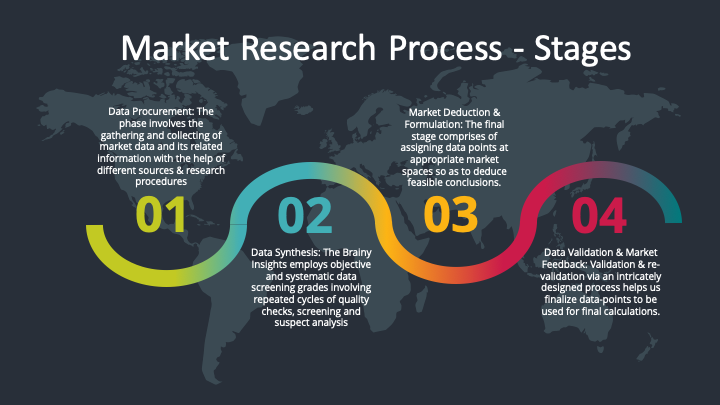
The phase involves the gathering and collecting of market data and its related information with the help of different sources & research procedures.
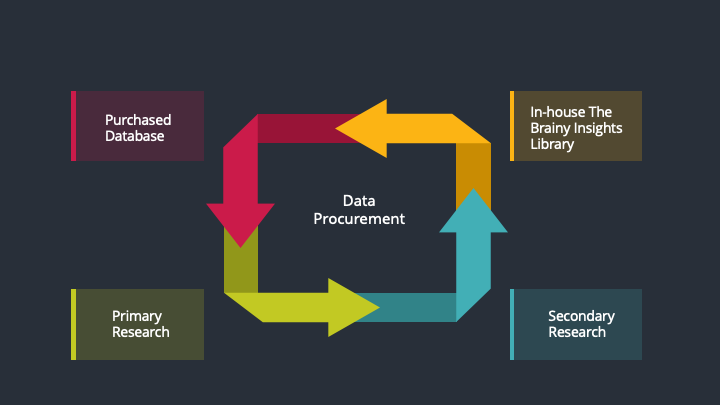
The data procurement stage involves in data gathering and collecting through various data sources.
This stage involves in extensive research. These data sources includes:
Purchased Database: Purchased databases play a crucial role in estimating the market sizes irrespective of the domain. Our purchased database includes:
Primary Research: The Brainy Insights interacts with leading companies and experts of the concerned domain to develop the analyst team’s market understanding and expertise. It improves and substantiates every single data presented in the market reports. Primary research mainly involves in telephonic interviews, E-mail interactions and face-to-face interviews with the raw material providers, manufacturers/producers, distributors, & independent consultants. The interviews that we conduct provides valuable data on market size and industry growth trends prevailing in the market. Our organization also conducts surveys with the various industry experts in order to gain overall insights of the industry/market. For instance, in healthcare industry we conduct surveys with the pharmacists, doctors, surgeons and nurses in order to gain insights and key information of a medical product/device/equipment which the customers are going to usage. Surveys are conducted in the form of questionnaire designed by our own analyst team. Surveys plays an important role in primary research because surveys helps us to identify the key target audiences of the market. Additionally, surveys helps to identify the key target audience engaged with the market. Our survey team conducts the survey by targeting the key audience, thus gaining insights from them. Based on the perspectives of the customers, this information is utilized to formulate market strategies. Moreover, market surveys helps us to understand the current competitive situation of the industry. To be precise, our survey process typically involve with the 360 analysis of the market. This analytical process begins by identifying the prospective customers for a product or service related to the market/industry to obtain data on how a product/service could fit into customers’ lives.
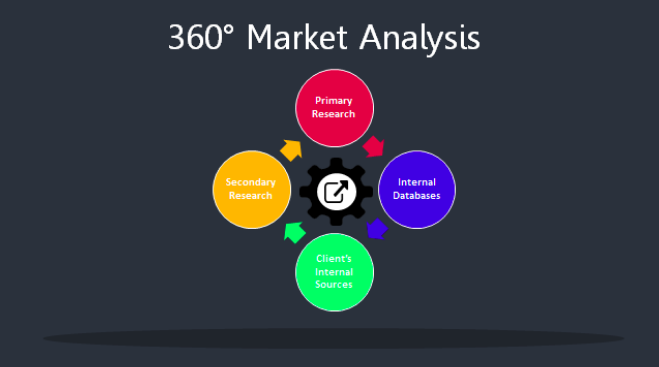
Secondary Research: The secondary data sources includes information published by the on-profit organizations such as World bank, WHO, company fillings, investor presentations, annual reports, national government documents, statistical databases, blogs, articles, white papers and others. From the annual report, we analyse a company’s revenue to understand the key segment and market share of that organization in a particular region. We analyse the company websites and adopt the product mapping technique which is important for deriving the segment revenue. In the product mapping method, we select and categorize the products offered by the companies catering to domain specific market, deduce the product revenue for each of the companies so as to get overall estimation of the market size. We also source data and analyses trends based on information received from supply side and demand side intermediaries in the value chain. The supply side denotes the data gathered from supplier, distributor, wholesaler and the demand side illustrates the data gathered from the end customers for respective market domain.
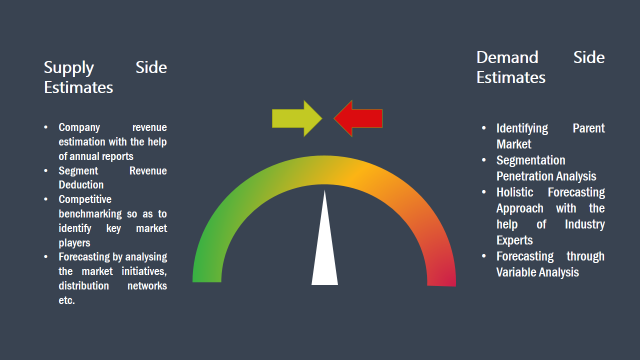
The supply side for a domain specific market is analysed by:
The demand side for the market is estimated through:
In-house Library: Apart from these third-party sources, we have our in-house library of qualitative and quantitative information. Our in-house database includes market data for various industry and domains. These data are updated on regular basis as per the changing market scenario. Our library includes, historic databases, internal audit reports and archives.
Sometimes there are instances where there is no metadata or raw data available for any domain specific market. For those cases, we use our expertise to forecast and estimate the market size in order to generate comprehensive data sets. Our analyst team adopt a robust research technique in order to produce the estimates:
Data Synthesis: This stage involves the analysis & mapping of all the information obtained from the previous step. It also involves in scrutinizing the data for any discrepancy observed while data gathering related to the market. The data is collected with consideration to the heterogeneity of sources. Robust scientific techniques are in place for synthesizing disparate data sets and provide the essential contextual information that can orient market strategies. The Brainy Insights has extensive experience in data synthesis where the data passes through various stages:
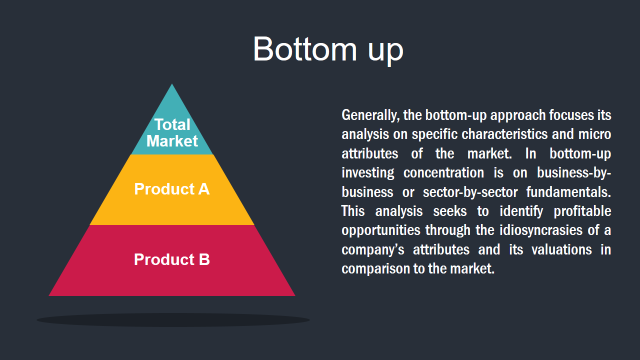
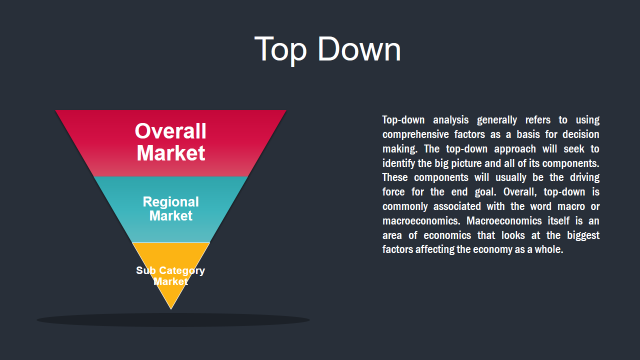
Market Deduction & Formulation: The final stage comprises of assigning data points at appropriate market spaces so as to deduce feasible conclusions. Analyst perspective & subject matter expert based holistic form of market sizing coupled with industry analysis also plays a crucial role in this stage.
This stage involves in finalization of the market size and numbers that we have collected from data integration step. With data interpolation, it is made sure that there is no gap in the market data. Successful trend analysis is done by our analysts using extrapolation techniques, which provide the best possible forecasts for the market.
Data Validation & Market Feedback: Validation is the most important step in the process. Validation & re-validation via an intricately designed process helps us finalize data-points to be used for final calculations.

The Brainy Insights interacts with leading companies and experts of the concerned domain to develop the analyst team’s market understanding and expertise. It improves and substantiates every single data presented in the market reports. The data validation interview and discussion panels are typically composed of the most experienced industry members. The participants include, however, are not limited to:
Moreover, we always validate our data and findings through primary respondents from all the major regions we are working on.



















































Free Customization
Fortune 500 Clients
Free Yearly Update On Purchase Of Multi/Corporate License
Companies Served Till Date