- +1-315-215-1633
- sales@thebrainyinsights.com

The global additive manufacturing in aerospace market was valued at USD 4.50 billion in 2024 and grew at a CAGR of 16% from 2025 to 2034. The market is expected to reach USD 19.85 billion by 2034. The rapid technological advancements will drive the growth of the global additive manufacturing in aerospace market.
Additive manufacturing (AM) or 3D printing is the new technology in the field of aerospace which consists of a layer-by-layer accumulation of the parts of the components based on the digital images. The materials that are used for additive manufacturing in aerospace may include metals, polymers, and composites. Additive Manufacturing has some major strengths in the aerospace industry such as making things lighter, making them perform better, and quicker prototyping and subsequent manufacturing. In aviation and space applications, lighter parts can have a significant benefit because reduction of a small amount of weight can result in a large fuel savings and incremental payloads. AM can manufacture components whose internal structure is complex, e.g. featuring lattice structures, which help in increasing strength-to-weight ratios and thermodynamic efficiency, which is essential in aerospace applications. AM is used extensively in production of components such as fuel nozzles, brackets and engine parts and airframe structures. As an example, GE Aviation has already managed to deploy AM to manufacture fuel nozzles on jet engines and has integrated several components into one printed object that is both lighter and stronger. Besides, additive manufacturing enables the quick iteration and made-to-order production of parts, particularly the prototyping production and low-volume manufacturing processes. It also improves supply chain efficiencies as it allows decentralized production which minimises the requirement of large inventories and long shipping distances.
Get an overview of this study by requesting a free sample
Technological advancements and increasing applications of additive manufacturing – AM enables lightweight and optimized structure of parts, i.e. lattice and topology optimized components which also reduce the fuel consumption and emissions. This is particularly important in commercial as well as military aviation where the costs and environmental efficiency are directly related to operational efficiency. The other significant driver is design flexibility. In contrast to traditional manufacturing processes, AM allows the production of intricate geometries and consolidation of parts into one printed part. This does not only save assembly time and possible points of failure but also leads to a better performance and reliability of the parts overall. Moreover, AM enables quick prototyping and design iteration processes, which can greatly speed up the production of new aerospace parts due to the engineers no longer having to wait until costly tooling is available to test and iterate a design. The other major factor is customization and low volume manufacturing. Additionally, AM helps in streamlining the supply chain through its capacity to support on demand production which minimizes inventory needs and reduces downtime. The implications of AM on the aerospace industry are that it lends itself to innovation, efficiency and high-performance manufacturing by offering the industry a more efficient and flexible method of streamlining the production process.
Economic and technological considerations - The primary obstacle is high costs of initial investment into AM systems, especially, metals-based ones. The machines and related software, maintenance and infrastructure requirement will require a large capital outlay and most small and mid-sized aerospace suppliers will find it hard to justify the capital outlay without a definite and imminent pay-off (return on investment-ROI). The cost advantage of AM is in a significant portion of cases achievable only in the long term or in very narrow, specialized uses or applications and thus cannot be as readily applied in general production. ROI uncertainty is another issue that contributes to hindrance. Although AM creates an obvious performance and functional usefulness with complex and lightweight pieces, the cost merits are unclear with standardized, high-quantity components that still have more cost-effective and efficient traditional techniques. Also, the digital character of AM adds the aspects of cybersecurity and intellectual property issues. Unless kept safe, design files may be stolen, copied, and improperly reproduced, or hacked into data, which is a very delicate position to be in when dealing with defence and aerospace companies. The integration of AM into the aerospace supply chain becomes further complicated when there are no coordinated industry-wide standards that will help suppliers and OEMs coordinate their work, making this cooperation much more fragmented.
The increasing awareness and acceptance of additive manufacturing – the increasing popularity of additive manufacturing (AM) in the aerospace sector is influenced positively by the general tendencies on the market, regulations, and technological advancements. The main force is the growth of international air transport worldwide and by extension, the growth of commercial and military aircraft. Efforts are therefore underway to streamline the production by implementing advanced and quick production technologies such as AM to both accelerate production in the wake of this aerospace manufacturing demand, as well as the need to design efficient methods that could enhance the performances of the products. Coupled with this is the emphasis that is currently being seen by the world on sustainability and some tightening of the emissions regulations, the companies are being enticed into investing in cleaner technologies. AM facilitates these ambitions by making lighter and more fuel-efficient parts, as well as minimizing material waste in the production process. AM is also being adopted because of technological innovations. Advancement of high-performance materials, which include aerospace grade metal alloys and composites, as well as advancement in the accuracy of printing, speed and post process ability have greatly improved the reliability and feasibility of AM to manufacture critical aerospace components. The developments are increasing competition of AM against traditional production in terms of sale of structural and engine parts.
The regions analyzed for the market include North America, Europe, South America, Asia Pacific, the Middle East, and Africa. North America emerged as the most significant global additive manufacturing in aerospace market, with a 40% market revenue share in 2024.
The North America aerospace additive manufacturing (AM) market has a commanding presence in the world due to the advanced presence of the aerospace industry in North America, the thriving research foundation and great investment in innovation. Among the world leading aerospace companies are some of the largest aerospace enterprises of the United States, namely, Boeing, Lockheed Martin, Northrop Grumman, and GE Aviation, all of which are among the first and major investors in the field of AM. Such companies have managed to incorporate additive manufacturing into their manufacturing and prototyping pathways and utilize it to manufacture high-performance parts like fuel nozzles, turbine blades, and structural components. The area is also home to many the leading AM technology companies, including Stratasys, 3D Systems, and GE Additive, and this serves to further solidify the area as the leader in the field of AM not only in development but also implementation. North America boasts of a well-developed ecosystem made up of top universities, research labs, and government organizations such as NASA and the U.S. Department of Defence, which are facilitating and actively contributing to AM research efforts and its implementation. These alliances in the pursuit of faster paces of technical innovations and application of additive manufacturing in commercial and military aviation services. Additionally, North America has been leading in regulatory and certification regulations that govern AM parts and this aspect is critical in facilitating their applications in aircraft application of AM parts.
North America Region Additive Manufacturing in Aerospace Market Share in 2024 - 40%
www.thebrainyinsights.com
Check the geographical analysis of this market by requesting a free sample
The technology segment is divided into powder bed fusion (PBF), directed energy deposition (DED), binder jetting, material extrusion and vat photopolymerization. The power bed fusion (PBF) segment dominated the market, with a market share of around 36% in 2024. The dominant place among the additive manufacturing technologies is occupied by the Powder Bed Fusion (PBF) technology, which is used by the aerospace industry because of its precision, versatility in material choices, and making high-performance, complex components. PBF covers a large number of variations which include Selective Laser Melting (SLM), Electron Beam Melting (EBM), and Direct Metal Laser Sintering (DMLS). The compatibility of PBF with aerospace grade alloys of titanium alloys, Inconel (nickel), and aluminium is one of the reasons why PBF is the most dominant in the market. PBF is a technology that also enables merging several elements into one element, decreasing the cost of weight, the numbers of ways to break down, and structuring the supply chain and maintenance easier. On top of this, the aerospace industry appreciates the high resolution surface finishes and mechanical properties that can be attained using PBF and they are typically able to perform at the necessary levels that the conventional manufacturing methods would handle. Consequently, key aerospace OEMs have devoted a lot of money to both the prototyping and production applications of the PBF systems. Nevertheless, the unrivalled consistency and performance characteristics of PBF make it the aerospace gold standard among the manufacturing technologies available right now.
The material type segment is divided into metals, polymers, composites and ceramics. The metals segment dominated the market, with a market share of around 37% in 2024. It is clear that metals dominate the material portion of additive manufacturing (AM) in the aerospace industry because of their excellent mechanical characteristics, resistant thermal properties, and also the fact that they can be used in critical structural and engine parts. The aerospace industry requires materials that can have an extreme operating environment that includes high temperatures, enormous pressure, and the stress of repeated milling, all in which metals like titanium, aluminium, and nickel-based superalloys perform well. These materials can not only provide the required strength and durability but also assist in weight reduction which is an important consideration to achieve the desired effect of providing fuel efficiency and other desirable aspects of aircraft performance. Since metal AM technologies keep evolving, with an increasing number of materials, build speed and process reliability, it can be stated with a high degree of certainty that it will solidify its central position in the aerospace additive manufacturing even more rigorously.
The application segment is divided into engine components, structural components, interior components, tooling and fixtures and prototyping. The engine components segment dominated the market, with a market share of around 42% in 2024. The component most used by aerospace industry in additive manufacturing (AM) is the engine part as it addresses the most rigorous performance requirements and encompasses the major benefits of AM in weight reduction, design-optimization, and thermal performance. Jet engines work in very uneven conditions, a very high temperature and stress in the engine that require materials of great strength and resistant to heat. Additive manufacturing, especially metallic approaches, such as Powder Bed Fusion (PBF), can fabricate complex, high-performance components, in the engine, that addresses these stringent requirements. The fuel nozzle is one of the most recognizable AM applications in the aerospace engines. This not only does this make it easier to assemble, cutting down points where difficulties might be encountered but it also makes it more fuel efficient by making fuel easier to move and burn. Likewise, turbine blades, heat exchangers, and combustion liners are now also being redesigned through AM with the aim of adding internal cooling channels and complex geometries that enhance thermal management and overall engine efficiency. The parts that benefit significantly to AM are in the engine sector because the opportunity to decrease the weight of the parts and soave their structure is tremendous. Fuel savings and extended range of aircraft can be transferred to actual fuel savings expressed in gallons with even light weight removal in engine. Also, AM can speed the development of new engine designs, decreasing the time to develop next-generation propulsion systems through prototyping and testing.
The platform segment is divided into aircraft, spacecraft and UAVs (unmanned aerial vehicles). The aircraft segment dominated the market, with a share of around 45% in 2024. The aircraft segment of aerospace additive manufacturing (AM) is in the majority owing to the magnitude of the demand, variety of applications along with the constant need to enhance in terms of performance and efficiency in commercial and military aviation. When compared to spacecraft and UAVs, aircraft fly on a regular basis under high-demand conditions in which they need more durable, lightweight, and carefully designed pieces. The increasing requirements of these demands are being fulfilled through AM which allows the manufacturing of complex parts of low weight, high geometrical optimization and material saving. In aviation industry, the major players of original equipment manufacturers (OEMs), such as Boeing or Airbus, are integrating the AM parts in structural assemblies, and engine systems, as well as cabin interiors. The efficacy of AM not only ensures that aircraft weight is minimized thus ensuring greater fuel efficiency with reduced emissions but also it makes production cycles faster and that is essential in an industry where in high volume and short delivery can easily become the defining characteristics. In military aviation, both new aircraft designs and life extension of aging fleets are carried out through AM. The flexibility of producing mission-specific or hard to source parts as-needed is extremely useful in the defence sector where operational readiness and availabilities of logistical support are paramount. Furthermore, aircrafts have the advantage of the maturity of AM technologies and materials which are ready and available in line with the aviation certification requirements.
The end-user segment is divided into OEMs (original equipment manufacturers) and MRO (maintenance, repair, and overhaul) providers). The OEMs (original equipment manufacturers) segment dominated the market, with a share of around 55% in 2024. The reason why OEMs have a commanding rate in the aerospace additive manufacturing (AM) business lies in the fact that they are in complete charge regarding the design, manufacturing, and incorporating advancing technologies in aircraft. The leading OEM in the commercial and defence aerospace system integration of AM is Boeing Airbus, Lockheed Martin and GE Aviation. Their research, equipment and certification processes are what enable them to invest a lot and therefore place them in a strategic position of using AM in high value applications such as engine components, structural components, and interior components including customized ones. When it comes to AM, no other entity is better suited to take advantage of the myriads of potential benefits with respect to business, manufacturing and fuel costs than OEMs in theory since they control the lifecycle of product creation, beginning with concept and design, continuing with manufacturing and support. This enables them to apply a design-for-additive-manufacturing (DfAM) process whereby they optimize parts initially to exploit the benefits of AM, including weight savings, partial parts consolidation, complex shapes. To give an example, the use of AM by GE Aviation in the production of fuel nozzle has led to more efficient and lightweight components, which have reduced joints with connection and increased durability. Furthermore, the industry is working towards standardized industry standards and certification procedures on AM (additive manufacturing) parts through the efforts of OEMs, which is an important determinant to achieve regulatory bodies and safe assimilation into the aircraft systems.
| Attribute | Description |
|---|---|
| Market Size | Revenue (USD Billion) |
| Market size value in 2024 | USD 4.50 Billion |
| Market size value in 2034 | USD 19.85 Billion |
| CAGR (2025 to 2034) | 16% |
| Historical data | 2021-2023 |
| Base Year | 2024 |
| Forecast | 2025-2034 |
| Region | The regions analyzed for the market are Asia Pacific, Europe, South America, North America, and Middle East and Africa. Furthermore, the regions are further analyzed at the country level. |
| Segments | Technology, Material Type, Application, Platform and End-User |
As per The Brainy Insights, the size of the global additive manufacturing in aerospace market was valued at USD 4.50 billion in 2024 to USD 19.85 billion by 2034.
Global additive manufacturing in aerospace market is growing at a CAGR of 16% during the forecast period 2025-2034.
The market's growth will be influenced by technological advancements and increasing applications of additive manufacturing.
Economic and technological considerations could hamper the market growth.
This study forecasts revenue at global, regional, and country levels from 2021 to 2034. The Brainy Insights has segmented the global additive manufacturing in aerospace market based on below mentioned segments:
Global Additive Manufacturing in Aerospace Market by Technology:
Global Additive Manufacturing in Aerospace Market by Material:
Global Additive Manufacturing in Aerospace Market by Application:
Global Additive Manufacturing in Aerospace Market by Platform:
Global Additive Manufacturing in Aerospace Market by End-User:
Global Additive Manufacturing in Aerospace Market by Region:
Research has its special purpose to undertake marketing efficiently. In this competitive scenario, businesses need information across all industry verticals; the information about customer wants, market demand, competition, industry trends, distribution channels etc. This information needs to be updated regularly because businesses operate in a dynamic environment. Our organization, The Brainy Insights incorporates scientific and systematic research procedures in order to get proper market insights and industry analysis for overall business success. The analysis consists of studying the market from a miniscule level wherein we implement statistical tools which helps us in examining the data with accuracy and precision.
Our research reports feature both; quantitative and qualitative aspects for any market. Qualitative information for any market research process are fundamental because they reveal the customer needs and wants, usage and consumption for any product/service related to a specific industry. This in turn aids the marketers/investors in knowing certain perceptions of the customers. Qualitative research can enlighten about the different product concepts and designs along with unique service offering that in turn, helps define marketing problems and generate opportunities. On the other hand, quantitative research engages with the data collection process through interviews, e-mail interactions, surveys and pilot studies. Quantitative aspects for the market research are useful to validate the hypotheses generated during qualitative research method, explore empirical patterns in the data with the help of statistical tools, and finally make the market estimations.
The Brainy Insights offers comprehensive research and analysis, based on a wide assortment of factual insights gained through interviews with CXOs and global experts and secondary data from reliable sources. Our analysts and industry specialist assume vital roles in building up statistical tools and analysis models, which are used to analyse the data and arrive at accurate insights with exceedingly informative research discoveries. The data provided by our organization have proven precious to a diverse range of companies, facilitating them to address issues such as determining which products/services are the most appealing, whether or not customers use the product in the manner anticipated, the purchasing intentions of the market and many others.
Our research methodology encompasses an idyllic combination of primary and secondary initiatives. Key phases involved in this process are listed below:

The phase involves the gathering and collecting of market data and its related information with the help of different sources & research procedures.
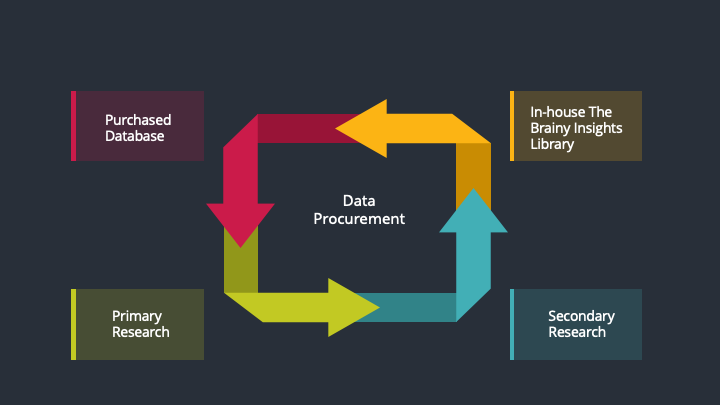
The data procurement stage involves in data gathering and collecting through various data sources.
This stage involves in extensive research. These data sources includes:
Purchased Database: Purchased databases play a crucial role in estimating the market sizes irrespective of the domain. Our purchased database includes:
Primary Research: The Brainy Insights interacts with leading companies and experts of the concerned domain to develop the analyst team’s market understanding and expertise. It improves and substantiates every single data presented in the market reports. Primary research mainly involves in telephonic interviews, E-mail interactions and face-to-face interviews with the raw material providers, manufacturers/producers, distributors, & independent consultants. The interviews that we conduct provides valuable data on market size and industry growth trends prevailing in the market. Our organization also conducts surveys with the various industry experts in order to gain overall insights of the industry/market. For instance, in healthcare industry we conduct surveys with the pharmacists, doctors, surgeons and nurses in order to gain insights and key information of a medical product/device/equipment which the customers are going to usage. Surveys are conducted in the form of questionnaire designed by our own analyst team. Surveys plays an important role in primary research because surveys helps us to identify the key target audiences of the market. Additionally, surveys helps to identify the key target audience engaged with the market. Our survey team conducts the survey by targeting the key audience, thus gaining insights from them. Based on the perspectives of the customers, this information is utilized to formulate market strategies. Moreover, market surveys helps us to understand the current competitive situation of the industry. To be precise, our survey process typically involve with the 360 analysis of the market. This analytical process begins by identifying the prospective customers for a product or service related to the market/industry to obtain data on how a product/service could fit into customers’ lives.
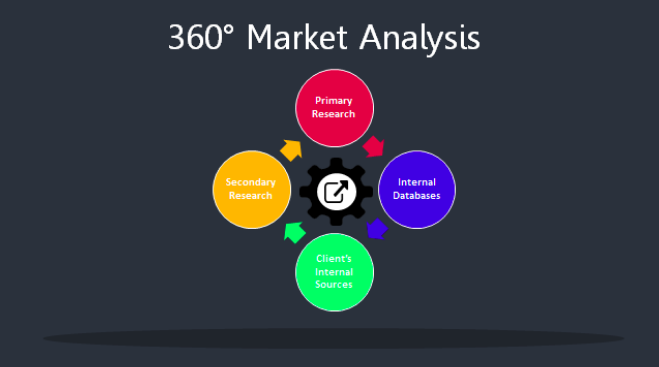
Secondary Research: The secondary data sources includes information published by the on-profit organizations such as World bank, WHO, company fillings, investor presentations, annual reports, national government documents, statistical databases, blogs, articles, white papers and others. From the annual report, we analyse a company’s revenue to understand the key segment and market share of that organization in a particular region. We analyse the company websites and adopt the product mapping technique which is important for deriving the segment revenue. In the product mapping method, we select and categorize the products offered by the companies catering to domain specific market, deduce the product revenue for each of the companies so as to get overall estimation of the market size. We also source data and analyses trends based on information received from supply side and demand side intermediaries in the value chain. The supply side denotes the data gathered from supplier, distributor, wholesaler and the demand side illustrates the data gathered from the end customers for respective market domain.
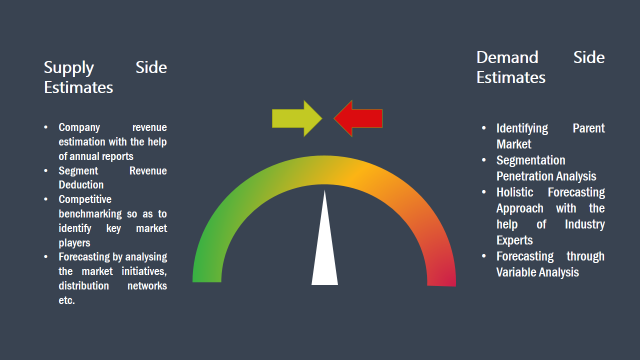
The supply side for a domain specific market is analysed by:
The demand side for the market is estimated through:
In-house Library: Apart from these third-party sources, we have our in-house library of qualitative and quantitative information. Our in-house database includes market data for various industry and domains. These data are updated on regular basis as per the changing market scenario. Our library includes, historic databases, internal audit reports and archives.
Sometimes there are instances where there is no metadata or raw data available for any domain specific market. For those cases, we use our expertise to forecast and estimate the market size in order to generate comprehensive data sets. Our analyst team adopt a robust research technique in order to produce the estimates:
Data Synthesis: This stage involves the analysis & mapping of all the information obtained from the previous step. It also involves in scrutinizing the data for any discrepancy observed while data gathering related to the market. The data is collected with consideration to the heterogeneity of sources. Robust scientific techniques are in place for synthesizing disparate data sets and provide the essential contextual information that can orient market strategies. The Brainy Insights has extensive experience in data synthesis where the data passes through various stages:
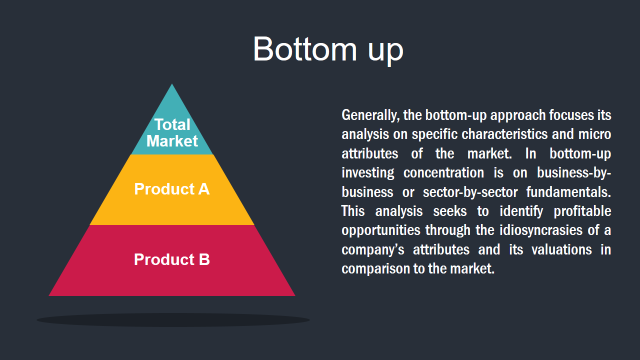

Market Deduction & Formulation: The final stage comprises of assigning data points at appropriate market spaces so as to deduce feasible conclusions. Analyst perspective & subject matter expert based holistic form of market sizing coupled with industry analysis also plays a crucial role in this stage.
This stage involves in finalization of the market size and numbers that we have collected from data integration step. With data interpolation, it is made sure that there is no gap in the market data. Successful trend analysis is done by our analysts using extrapolation techniques, which provide the best possible forecasts for the market.
Data Validation & Market Feedback: Validation is the most important step in the process. Validation & re-validation via an intricately designed process helps us finalize data-points to be used for final calculations.

The Brainy Insights interacts with leading companies and experts of the concerned domain to develop the analyst team’s market understanding and expertise. It improves and substantiates every single data presented in the market reports. The data validation interview and discussion panels are typically composed of the most experienced industry members. The participants include, however, are not limited to:
Moreover, we always validate our data and findings through primary respondents from all the major regions we are working on.



















































Free Customization
Fortune 500 Clients
Free Yearly Update On Purchase Of Multi/Corporate License
Companies Served Till Date